The best NotebookLM alternative depends on which of its two blind spots is hurting you. NotebookLM is excellent at reading, synthesizing, and turning uploaded documents into study material, and it never wanders beyond those sources, which keeps it honest. What it cannot do is find those documents or read them in another language: it has no academic search and no real corpus, and its translation is minimal. The question is rarely "what is the single best tool," but "what adds discovery and translation on top of the source-grounded notebook without giving up the trust that makes NotebookLM worth using."
That trust matters more than any feature. General chatbots still fabricate academic citations at an alarming rate: peer-reviewed studies have found GPT-4 inventing false references more than 20% of the time, and a GPT-4o study put the share of fake or error-laden citations at 56%. NotebookLM is popular precisely because it does the opposite, grounding every answer in your sources with clickable passages. Any alternative has to add search and translation without losing that anchor to the source.
Our top pick is Kenkyu.ai, because it keeps NotebookLM's source-grounded reading idea and adds the two things NotebookLM lacks: search across more than 200 million papers, and native-language translation of any of them, with answers that trace back to the exact source paragraph. For anyone who reads or cites work in more than one language, especially Japanese and English, that combination is hard to assemble elsewhere. If your only need is to synthesize and study sources you already have, NotebookLM may still be right, and we say so below.
Every tool here was scored 0 to 5 on the same 13-point rubric, grounded in documented features, pricing, and real user sentiment rather than marketing copy. For the wider field, our best AI academic research tools guide ranks the broader category.
At a glance: the best NotebookLM alternatives compared
Scores are 0 to 5 (higher is better). Citation trust is our shorthand for whether claims trace to real, correctly linked sources.
| Rank | Tool | Search | Synthesis | Citation trust | Translation | Value | Price | Best for | |
|---|---|---|---|---|---|---|---|---|---|
| Editor's pick | Kenkyu.ai | 3 | 3 | 3 | 4 | 4 | 4 | Free; Plus ~$8/mo | Search, translate, and cite papers in any language |
| 2 | SciSpace | 3 | 3 | 5 | 3 | 2 | 3 | Free; Premium $12/mo | A copilot for reading and decoding single papers |
| 3 | Anara | 2 | 3 | 5 | 4 | 1 | 3 | Free; Plus ~$10/mo | Collaborative cited chat across your own library |
| 4 | Paperguide | 3 | 3 | 3 | 3 | 0 | 5 | Free; Plus $12/mo | One affordable tool from discovery to writing |
| 5 | Elicit | 3 | 4 | 2 | 5 | 0 | 3 | Free; Plus ~$10/mo | Systematic reviews and data extraction at scale |
| 6 | Liner | 4 | 3 | 3 | 4 | 0 | 3 | Free; Pro $14.99/mo | A cheap all-in-one cited search and writing tool |
| 7 | Consensus | 4 | 3 | 1 | 4 | 0 | 4 | Free; Pro $10/mo | Fast, evidence-based yes or no questions |
| 8 | NotebookLM (the baseline) | 0 | 4 | 5 | 5 | 1 | 4 | Free; Plus ~$7.99/mo | Synthesizing and studying your own uploaded sources |
The one-line verdict on Kenkyu.ai: multilingual search across 200M+ papers, native-language translation, and answers you can trace back to the source paragraph, all in one tool with a free plan that needs no credit card.
What is NotebookLM?
NotebookLM is Google's source-grounded AI research and thinking partner, powered by Gemini. The defining trait is in the name: it works only with the sources you give it, whether PDFs, Google Docs, websites, YouTube videos, or pasted text, and answers from those alone, never searching the academic literature. Every response carries numbered references you can click to highlight the exact passage, the feature researchers praise most, because it makes verification take seconds and keeps the model from straying. Around that core sit its Studio outputs (Audio Overviews, mind maps, flashcards, quizzes), all generated from your sources. It holds a 4.8 out of 5 on G2 across a small sample, and an independent measure put its hallucination rate near 13% against roughly 40% for ChatGPT. The free tier is generous, with 50 sources per notebook.
The reasons people look for an alternative follow directly from the design. The first is discovery: NotebookLM cannot find papers, so you bring your own and pair it with a separate search tool. The second is language: its translation is minimal, so reading a non-English paper means translating it elsewhere first. Users also report the 50-source cap constraining real literature reviews, accuracy degrading near that cap, and limited export and collaboration. The tools below address those gaps while trying to preserve the grounded trust that makes NotebookLM good.
1. Kenkyu.ai, Editor's pick: add multilingual search and translation to the grounded notebook
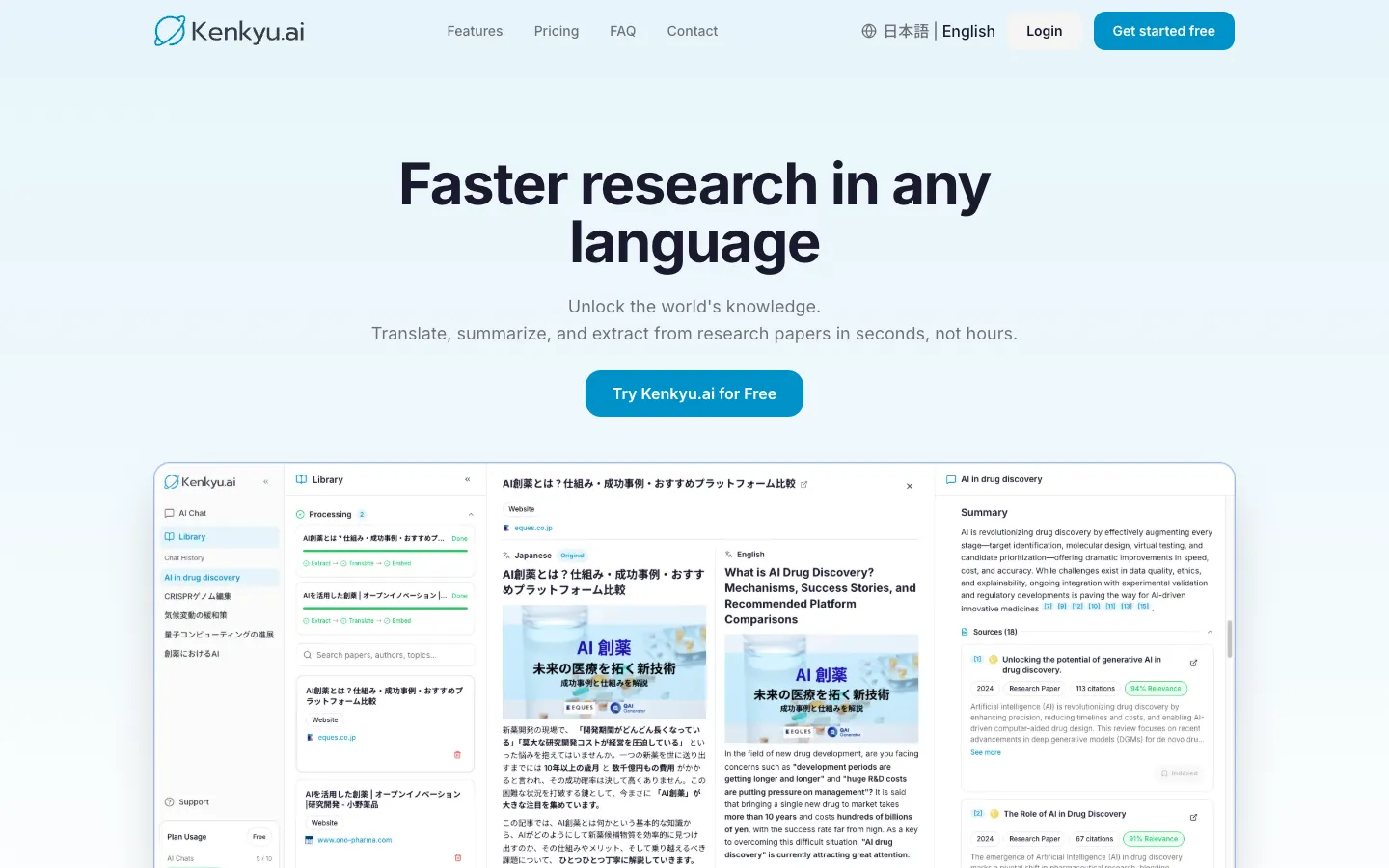
Score breakdown (0 to 5)
Search 3 · Coverage 4 · Synthesis 3 · Q&A 3 · PDF 3 · Data extraction 2 · Translation 4 · Citation trust 4 · Ease 4 · Value 4
Kenkyu.ai is our top pick for leaving NotebookLM because it closes its two gaps without abandoning the source-grounded approach that makes NotebookLM trustworthy. Where NotebookLM waits for you to supply documents, Kenkyu.ai searches the same 200M+ paper index that backs Semantic Scholar; where it barely translates, Kenkyu.ai renders any paper into your native language; and like NotebookLM, it answers with citations that resolve to the specific source paragraph, not just a paper title. This is an editorial pick rather than the highest raw score on every line: NotebookLM still beats Kenkyu.ai on pure document reading and Studio outputs, but it cannot find the next paper or read it in Japanese, Spanish, or Mandarin, and that is the job Kenkyu.ai is built for.
Key features
- Search across 200M+ papers (Semantic Scholar corpus) plus the web, the layer NotebookLM lacks
- Native-language translation of full papers in a bilingual reading view
- Cited answers that trace back to the specific source paragraph, not just a paper title
- Chat with uploaded PDFs, in a console available in English and Japanese
Strengths
Kenkyu.ai's standout is doing discovery, translation, and grounded answers in one workflow, exactly the assembly NotebookLM forces across three tools. Because citations resolve to the source passage, verification is as fast as in NotebookLM, which is why it scores a 4 on citation trust where general chatbots score a 1. The free plan is built for trying the tool stress free (unlimited search of the full index, plus 10 AI chats and 10 uploads per month, no credit card), and at roughly $8 per month (¥1,260), Plus is among the most reasonably priced paid tiers here.
Weaknesses
Kenkyu.ai is deliberately a research and reading tool, not a study-media generator, so it has no equivalent to NotebookLM's Audio Overviews, mind maps, or quizzes, and it scores a 0 on drafting. Reference management is light (you can save papers, but it is not a full Zotero replacement), there is no browser extension or Word integration yet, and it is a newer name with less brand recognition than a Google-backed product.
Price
Free (unlimited search of 200M+ papers, plus 10 AI chats and 10 uploads per month, no credit card). Plus is about $8 per month (¥1,260), with unlimited chat and uploads and larger file limits. Enterprise pricing is custom.
Best for
Multilingual researchers, students, clinicians, and journalists who use NotebookLM for reading but also need to discover and translate papers across languages, especially Japanese and English.
2. SciSpace: a reading copilot that can also search
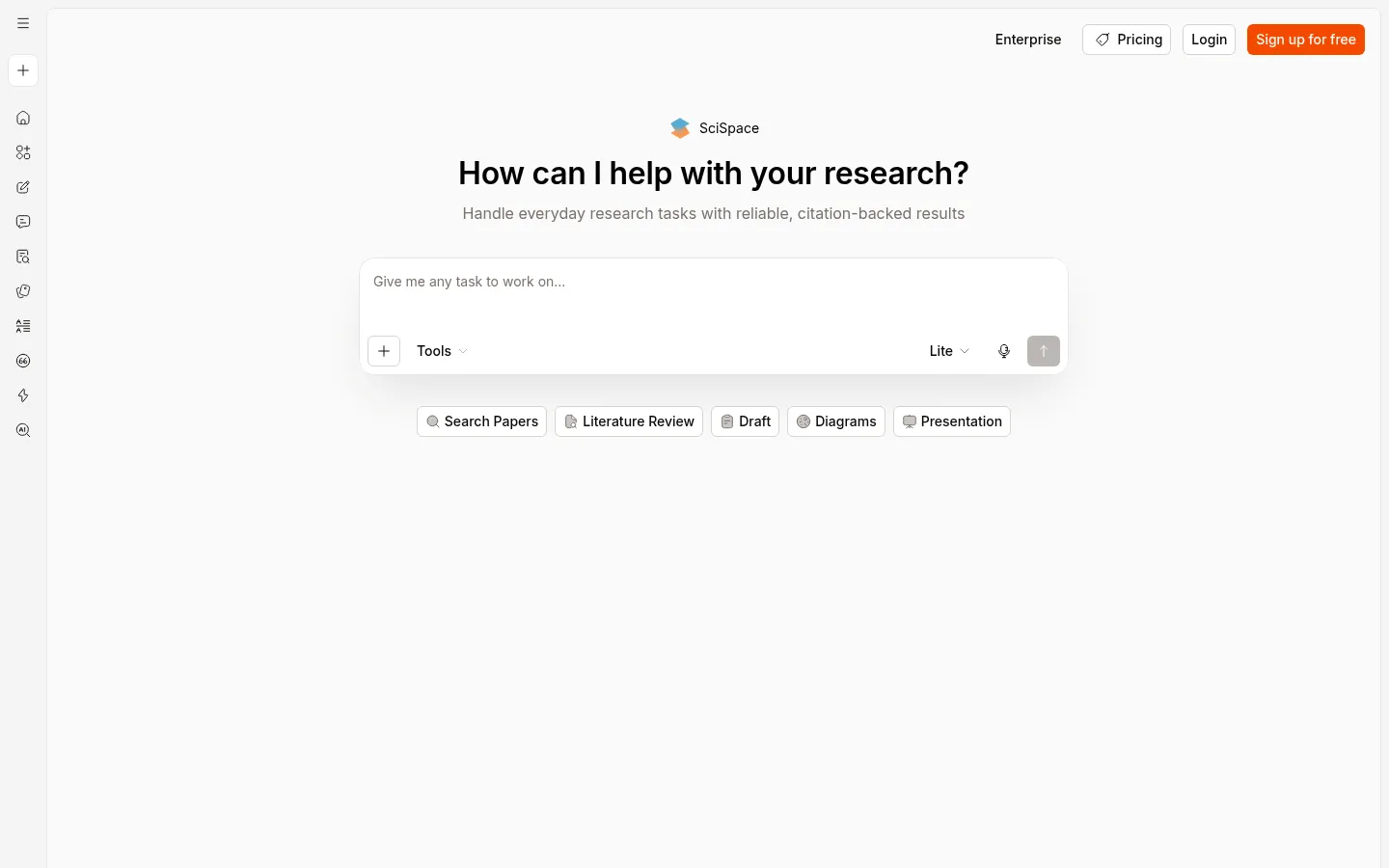
Score breakdown (0 to 5)
Search 3 · Coverage 5 · Synthesis 3 · Q&A 4 · PDF 5 · Data extraction 4 · Translation 2 · Citation trust 3 · Ease 3 · Value 3
If you reach for NotebookLM mainly to read and decode hard papers, SciSpace is the closest swap that also adds discovery. Its Chat with PDF copilot lets you highlight any passage for a plain-language explanation with deep links into the source, and unlike NotebookLM it can search, claiming the largest corpus here at 280M+ papers.
Key features
- Highlight-to-explain Chat with PDF with deep links into the source
- Large literature search index (280M+ claimed), the discovery layer NotebookLM has no equivalent for
- Data extraction tables across papers, plus writing, paraphrasing, and AI-detection tools
- Chrome extension, mobile app, and a ChatGPT plugin
Strengths
Reviewers single out the reading experience. Professor David Stuckler, who rates it 8 out of 10, calls it "one of the best for chatting with a PDF" and praises how it will "highlight the section and ask it to explain it to you so that a third grader would understand it." It holds a 4.3 out of 5 on Capterra across 79 reviews.
Weaknesses
The recurring complaint is opaque credit consumption: users report burning through credits faster than expected and being pushed to upgrade, with one professor refused a refund over consumed credits. Discovery returns a "partial set" rather than exhaustive recall, coverage thins on hard sciences and non-English work, and translation is basic (it scores a 2). For readers hitting credit walls, our SciSpace alternatives guide compares options that bill more predictably.
Price
Free tier available. Premium is $12 per month (annual), Advanced $70 per month, and Max $160 per month, all credit-based, with Enterprise custom.
Best for
Graduate students and postdocs who want NotebookLM-style reading plus discovery, and do not mind managing credits.
3. Anara: collaborative, cited chat across your own documents
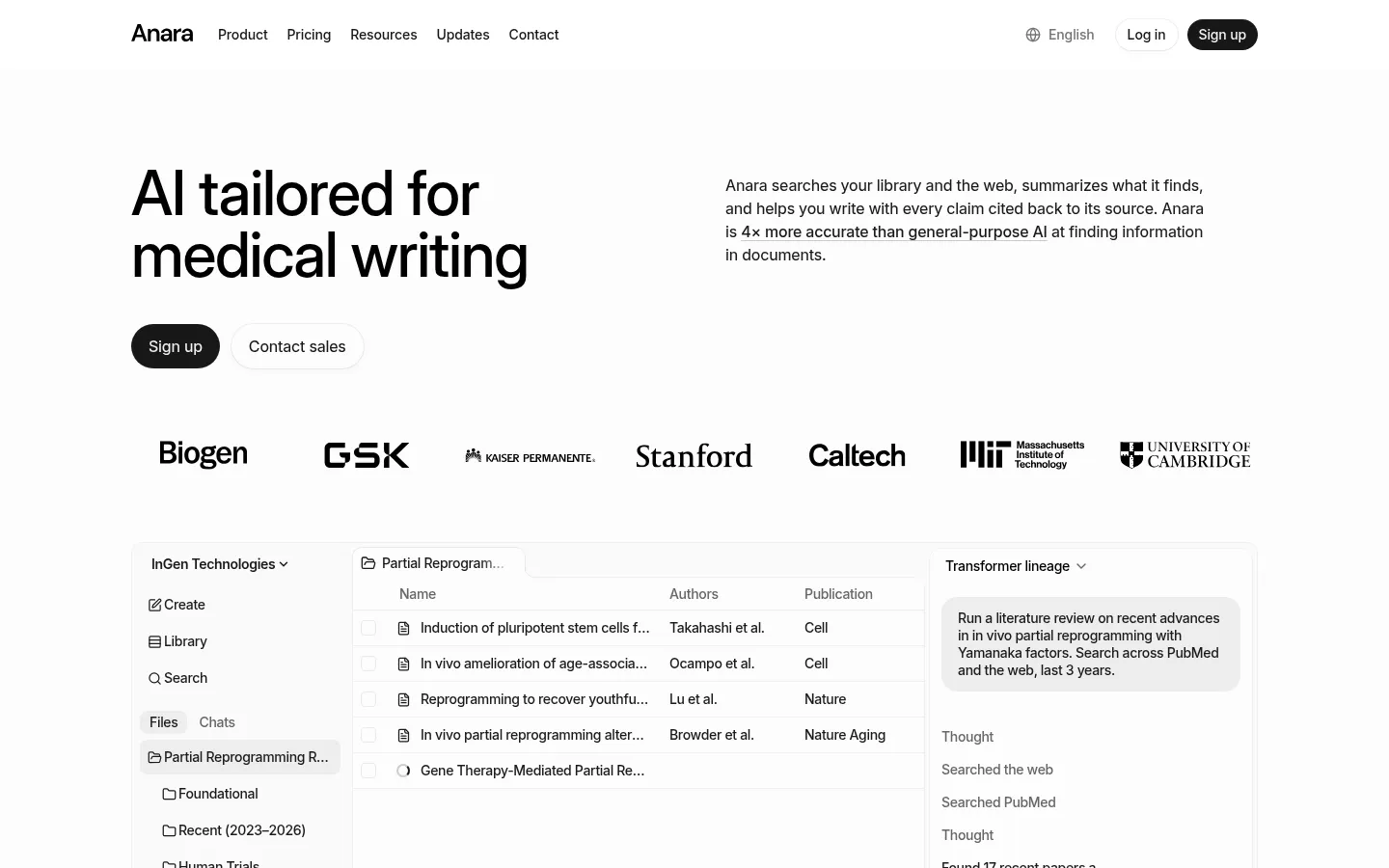
Score breakdown (0 to 5)
Search 2 · Coverage 1 · Synthesis 3 · Q&A 4 · PDF 5 · Data extraction 2 · Translation 1 · Citation trust 4 · Ease 4 · Value 3
Anara (formerly Unriddle) is the closest like-for-like to NotebookLM's core loop: upload documents and chat with them, every answer cited to a passage. Its signature Chat with Folder queries an entire library at once, and unlike single-user NotebookLM it adds team collaboration and reference-manager connectors, matching NotebookLM's 5 on document reading.
Key features
- Chat with Folder across an entire uploaded library, with passage-level citations on every answer
- Handles PDFs, video, audio, and images in one workspace
- Model choice (GPT, Claude, Gemini) and real-time collaboration, both absent in NotebookLM
- Connectors for Zotero, Mendeley, Drive, Notion, and OneDrive
Strengths
Reviewers praise the precision of its sourcing: citations are "consistently accurate and contextually relevant," and Anara "pulls references from the correct documents and highlights relevant sections," the grounded behavior that makes NotebookLM trustworthy. Multi-format support and model choice make it more versatile than NotebookLM for mixed media, collaboration is genuinely useful for labs, and privacy is a real strength (no training, GDPR, SOC2 at enterprise).
Weaknesses
Like NotebookLM, Anara is not a discovery engine: with no native corpus it reads only what you bring it (search and coverage score 2 and 1), so it solves NotebookLM's reading and collaboration gaps but not its discovery gap. It also draws skepticism over aggressive affiliate marketing, with researchers on Reddit calling much of the praise sponsored and at least one reporting an unexpected charge, so watch the billing.
Price
Free (2,000 words per day, 5 uploads per day). Plus is about $10 per month, Pro about $20 per month, and Max about $167 per month, with Enterprise custom.
Best for
Teams who want NotebookLM-style cited chat across their own libraries, with collaboration and reference-manager connectors.
4. Paperguide: the affordable all-in-one with real discovery
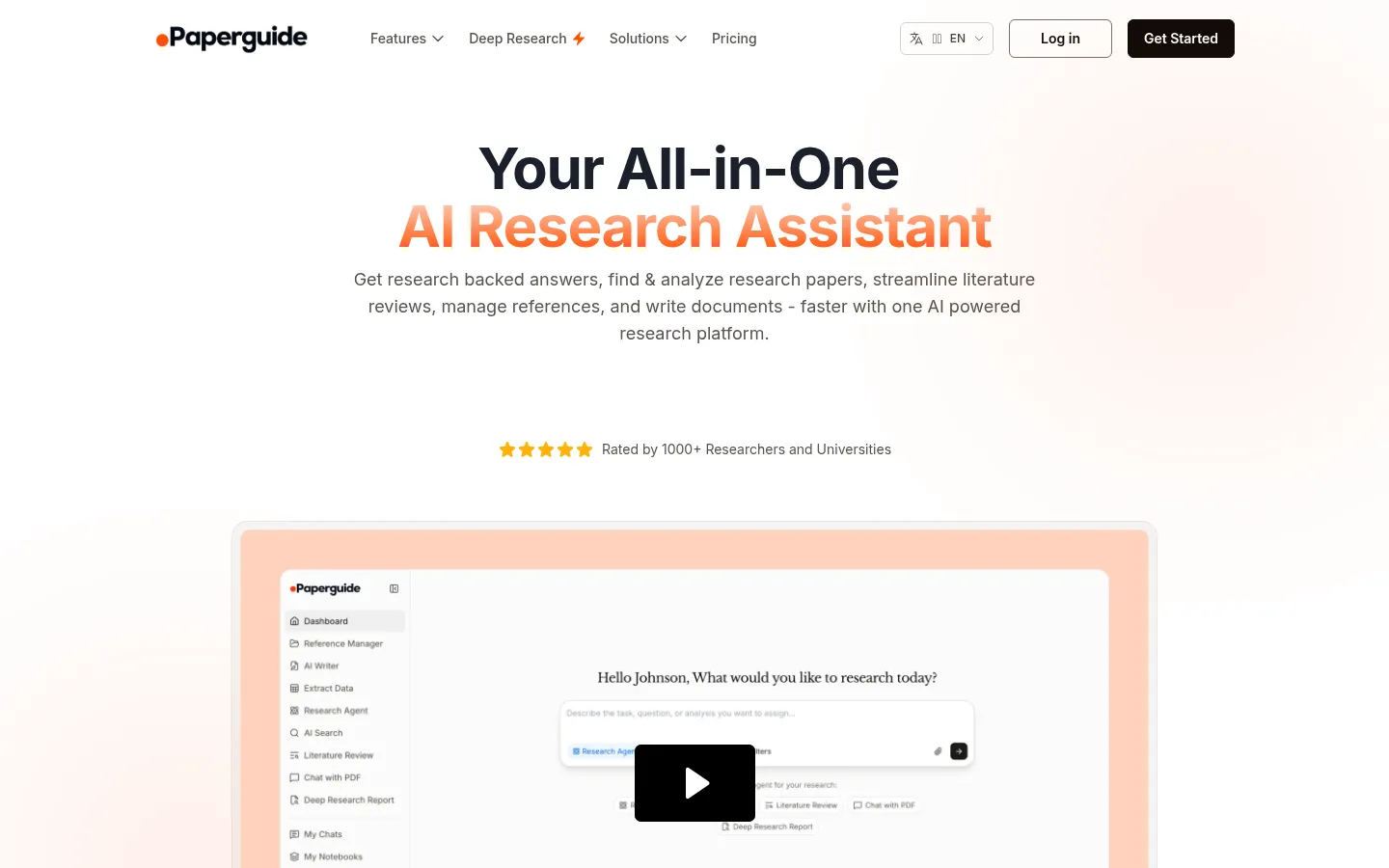
Score breakdown (0 to 5)
Search 3 · Coverage 4 · Synthesis 3 · Q&A 3 · PDF 3 · Data extraction 4 · Translation 0 · Citation trust 3 · Ease 4 · Value 5
Where NotebookLM does one stage of the workflow, Paperguide tries to do all of them: discovery, literature review, data extraction, a full reference manager, and cited writing, in one affordable place. It is the only tool here to score a 5 on value, for anyone tired of bolting a search tool and reference manager onto NotebookLM.
Key features
- AI search across 200M+ papers with journal-quality signals (SJR, SNIP, quartiles), the discovery NotebookLM omits
- Full reference manager with 1,000+ styles and many import paths
- Structured, multi-step literature review with screening control
- Data extraction, multi-paper Chat with PDF, and "Original Text for Verification" to check claims against the source
Strengths
The pitch is consolidation without the premium price, and budget-conscious users respond: Paperguide holds 4.3 out of 5 across 85 AppSumo reviews, and reviewers describe getting a "quick and customizable comparison of sources, within minutes instead of weeks of work." Surfacing journal-quality metrics, plus a verification view that shows the underlying text, gives it more research-rigor signals than NotebookLM, which never searches.
Weaknesses
Paperguide sits in the budget, lifetime-deal tier, and the trade-offs show: GPTZero and similar detectors flag its AI drafts, its 200M corpus trails SciSpace's 280M, and you still have to verify the papers it returns. Against NotebookLM specifically, it has no Audio Overviews or polished study outputs, and its brand awareness is far lower.
Price
Free (1,000 credits per month, 20 searches per month, plus the reference manager). Plus is $12 per month and Pro $24 per month, with a 40% student discount and Enterprise custom.
Best for
Budget-conscious students and researchers who want cited answers plus discovery, reference management, and writing in one tool.
5. Elicit: the systematic-review and data-extraction specialist
Score breakdown (0 to 5)
Search 3 · Coverage 4 · Synthesis 4 · Q&A 3 · PDF 2 · Data extraction 5 · Translation 0 · Citation trust 5 · Ease 3 · Value 3
NotebookLM is exploratory, built to understand sources you already have. Elicit is the opposite: systematic, built to screen and extract structured data across large bodies of literature with sentence-level citations. It is the only tool here to earn a 5 on data extraction, and if you are leaving NotebookLM to process hundreds of papers for a review rather than study a handful, this is the benchmark.
Key features
- Structured data-extraction tables with custom columns across many papers
- PRISMA-style screening across thousands of papers, a workflow NotebookLM has no version of
- Sentence-level citations on extracted claims
- Index of 138M+ papers plus 545k clinical trials, with a generous free search tier
Strengths
Elicit's accuracy on its core task is documented: in a case study with VDI/VDE IT, it correctly extracted 1,502 of 1,511 data points, a 99.4% accuracy rate. A common pairing makes the division of labor clear: as one widely upvoted Reddit comment put it, use "Elicit for discovery and initial filtering, NotebookLM for synthesis once you've decided which papers to include." Elicit supplies the discovery and screening layer NotebookLM is missing.
Weaknesses
Elicit is a screening and extraction engine, not a reader or a writer: there is no upload-and-chat PDF workflow (it scores a 2 on PDF analysis, below NotebookLM's 5) and no drafting support. Its own help center cautions that "Elicit summarizes the findings of a bad study just like it summarizes the findings of a good study," and there is a steep jump from the free tier to the $29 Pro plan. If you want side-by-side reading and study outputs, NotebookLM remains stronger; our Elicit alternatives guide weighs the trade-offs in more depth.
Price
Free (limited agent, 2 reports per month, unlimited search). Plus is about $10 per month, Pro $29 per month, and Scale $49 per month, with Enterprise custom.
Best for
Graduate students and researchers running systematic reviews and structured extraction, where finding and screening papers matters most.
6. Liner: a cheap, every-line-cited all-in-one
Score breakdown (0 to 5)
Search 4 · Coverage 4 · Synthesis 3 · Q&A 4 · PDF 3 · Data extraction 3 · Translation 0 · Citation trust 4 · Ease 3 · Value 3
Liner began as a Perplexity-style answer engine and pivoted toward students and researchers, bundling search, a Scholar agent, and a writing tool into one low-priced subscription. Compared with NotebookLM, the trade is clear: Liner leads on the discovery NotebookLM lacks (a 4 on search) and cites line by line, while NotebookLM leads on reading depth and study outputs.
Key features
- AI search with line-by-line citations on answers, the discovery NotebookLM omits
- Large claimed corpus (480M+ papers)
- Scholar agent for academic search and comparison tables, plus a built-in writing assistant
- Web, mobile, and browser extension (Scholar and Write are desktop-only)
Strengths
Liner's repeatable selling point is accurate, verifiable, every-line-cited search at a low price. It markets a 95.3% score on OpenAI's SimpleQA factual-accuracy test and reports 13M+ users, with roughly 83% positive reviews. Folding explore, synthesize, and write into one $14.99 tool makes it a credible budget all-rounder, and unlike NotebookLM it does the finding for you.
Weaknesses
The reputation risk is real: billing and refund complaints are among the most prominent themes in Liner's reviews, where NotebookLM, as a Google product, carries no such pattern. Accuracy caveats note it can over-generalize, the free tier is thin (credit-limited and ad-supported), and the mobile app draws bug reports. Its strength is cited search, not the deep document study NotebookLM is built for.
Price
Free (100 credits per month, ads). Pro is $14.99 per month (annual) and Max $29.99 per month, with Team and Enterprise tiers above.
Best for
Students and researchers who want NotebookLM-style citations on top of real search and light writing in one cheap subscription.
7. Consensus: the fastest way to ask a yes or no research question
Score breakdown (0 to 5)
Search 4 · Coverage 4 · Synthesis 3 · Q&A 4 · PDF 1 · Data extraction 3 · Translation 0 · Citation trust 4 · Ease 4 · Value 4
Consensus solves a different part of NotebookLM's discovery gap: instead of reading documents you supply, it searches the literature and tells you whether studies tend to support, oppose, or are mixed on a yes or no question. Its Consensus Meter reads across many papers at once, paired with the best pre-search filters here, on a 200M+ index NotebookLM has no equivalent for.
Key features
- The Consensus Meter: a support, oppose, or mixed verdict across many studies
- Best-in-class filters (year, journal rank, citation count, methodology, field, population)
- Study Snapshot extracting population, methods, outcomes, and results
- Deep Search for automated mini reviews, on a 200M+ paper index
Strengths
For "what does the literature say" questions, Consensus is fast and trustworthy. A grad-school reviewer noted that for yes or no questions "it will even count the articles that say yes, possibly, and no in their consensus meter." Its filtering is unusually deep, its Study Snapshots are especially useful in medical domains, and it is free to try, with a low $10 Pro tier and student and clinician discounts.
Weaknesses
The Consensus Meter is also the boundary of the tool: it shines on yes or no questions and is weaker on open-ended ones. There is no deep-linking into PDFs, so verifying a finding means opening the source yourself (PDF scores a 1, far below NotebookLM's 5), and because results carry some randomness they are not reproducible, which rules Consensus out for formal systematic reviews. It does no document reading or study-output generation, so it complements NotebookLM rather than replacing it.
Price
Free (15 Pro messages per month, 3 Deep reviews per month). Pro is $10 per month and Deep $45 per month, with up to a 40% student and clinician discount and Team or Enterprise custom.
Best for
Students, researchers, and clinicians who need fast, evidence-based scoping of yes or no questions.
8. NotebookLM: the source-grounded synthesis and study tool you are comparing
Score breakdown (0 to 5)
Search 0 · Coverage 0 · Synthesis 4 · Q&A 4 · PDF 5 · Data extraction 3 · Translation 1 · Citation trust 5 · Ease 5 · Value 4
It is worth scoring NotebookLM on the same rubric, because for the job it is built for it is excellent and free, and many readers should keep it alongside whatever they add. It scores a 5 on citation trust, PDF reading, and ease of use, and its Studio outputs (podcast-style Audio Overviews, mind maps, quizzes) are the best here for turning sources into study material. The honest verdict: NotebookLM is not a tool you "replace" so much as one you extend with search and translation.
Key features
- Strict source-grounding with clickable in-line passage citations
- Audio Overviews, mind maps, quizzes, and other Studio outputs
- Strong multi-document Q&A and synthesis in a near-effortless interface
- Free tier with 50 sources per notebook
Strengths
For making sense of material you already have, NotebookLM is hard to beat. Researchers describe replacing general web search for deep reading: one widely upvoted account reported cutting research time from "2 to 3 hours" down to "30 to 40 minutes with better clarity." Power users go further, turning a saved chat answer into a new source and using mind maps to spot research gaps where coverage is thin.
Weaknesses
The two defining limits are the reason this page exists. NotebookLM cannot find papers (search and corpus both score 0), so you must bring your own sources, and its translation is minimal (it scores a 1). Beyond those, the free notebook caps at 50 sources, accuracy degrades near that cap, export and collaboration are limited, and Audio Overviews can occasionally skip key points or invent details. It is a synthesis tool that needs a discovery and translation partner.
Price
Free (50 sources per notebook). Plus is about $7.99 per month and Pro about $19.99 per month, with higher Google tiers above that.
Best for
Synthesizing and studying your own uploaded PDFs and notes. Pair it with a search-and-translate tool to discover or read literature across languages.
How we scored the best NotebookLM alternatives
Every tool here is scored once on a shared 13-criterion rubric, 0 to 5, where 0 means a capability is absent or unusable and 5 means best in class. Scores are grounded in documented features, official pricing, and real user sentiment, not vendor marketing, and vendor-reported figures such as corpus sizes are treated conservatively as claims. The full method lives in our scoring framework.
Because NotebookLM is a source-grounded synthesis tool, this page weights the rubric toward what its users do and most need to add: synthesis and citation integrity carry the most weight, then PDF analysis, Q&A, search, coverage, and value. Translation is shown but not part of the ranking math. We rank by that weighted result, then place Kenkyu.ai first editorially for the discovery-plus-translation job rather than the highest raw composite, so you can re-weight the scores for your own priorities.
The field splits by job: NotebookLM, SciSpace, and Anara own document reading; Consensus and Liner lead on the discovery NotebookLM lacks; Elicit leads on extraction. Kenkyu.ai is the most balanced across discovery, reading, translation, and trust, which is why it is our pick for anyone who needs more than one of those jobs, especially across languages.

Written by
Timothy Andersen, Kenkyu.ai Founder