If you are looking for an Anara alternative, the honest answer is that Anara (formerly Unriddle) is genuinely good at one thing, reading and chatting with documents you already have, with answers cited back to the exact passage. The reason people still go looking is everything that sits around that: Anara does not find papers for you, it does not translate foreign-language research, and several researchers find its pricing steep once the free tier runs out. So the right alternative depends on which of those gaps you are trying to close.
Our top pick is Kenkyu.ai, because it solves the two jobs Anara leaves to you. It searches across more than 200 million papers and translates any one of them into your native language, then answers your questions with citations you can trace to the source paragraph. Where Anara waits for you to upload sources, Kenkyu.ai goes and finds them, in any language, and it does so on a free plan that needs no credit card. If your work is entirely in English and lives inside a folder of PDFs you already own, Anara's reading experience is hard to beat and we say so. If you also need to discover and read across languages, you are reading the right list.
Every tool below was scored 0 to 5 on the same 13-point rubric, grounded in documented features, real pricing, and user sentiment rather than marketing copy. The table comes first so you can scan the field, then each tool gets a full breakdown.
At a glance: the best Anara alternatives compared
Scores are 0 to 5 (higher is better). Citation trust is our shorthand for citation integrity: whether each claim traces to a real, correctly linked source. Anara sits last as the baseline you are comparing against, not because it scores poorly.
| Rank | Tool | PDF reading | Citation trust | Search | Translation | Value | Price (USD) | Best for |
|---|---|---|---|---|---|---|---|---|
| Editor's pick | Kenkyu.ai | 3 | 4 | 3 | 4 | 4 | Free; Plus ~$8/mo | Finding and reading papers across languages with traceable citations |
| 2 | Paperguide | 3 | 3 | 3 | 0 | 5 | Free; Plus $12/mo | One affordable tool from discovery to references and writing |
| 3 | SciSpace | 5 | 3 | 3 | 2 | 3 | Free; Premium $12/mo | Reading and explaining a single dense PDF |
| 4 | NotebookLM | 5 | 5 | 0 | 1 | 4 | Free; Plus ~$8/mo | Free source-grounded synthesis and study outputs |
| 5 | Logically | 4 | 3 | 3 | 1 | 4 | Free; Unlimited $12/mo | A cheap all-in-one cite-and-write workspace |
| 6 | Paperpal | 3 | 4 | 2 | 2 | 3 | Free; Prime ~$11.58/mo | Editing a manuscript to submission-ready |
| 7 | Liner | 3 | 4 | 4 | 0 | 3 | Free; Pro $14.99/mo | Accurate, every-line-cited search and writing |
| Baseline | Anara | 5 | 4 | 2 | 1 | 3 | Free; Plus ~$10/mo | Collaborative cited chat across your own document library |
The one-line verdict on Kenkyu.ai: multilingual search across 200M+ papers, native-language translation of any paper, and answers you can trace back to the source paragraph, all in one tool with a free plan that needs no credit card.
What is Anara?
Anara is an AI research workspace built around reading and chatting with documents you upload. Its signature feature is Chat with Folder: you drop a batch of PDFs into a folder and query the whole set at once, and every answer is cited back to a specific passage in a specific source. It also includes per-paper highlighting and comments, AI agents for tasks like form-filling and citation generation, a choice of underlying models (GPT, Claude, Gemini), and real-time collaboration so a team can work in the same library.
The product was called Unriddle until early 2025, when it rebranded to Anara to signal a move beyond simple summarization toward a fuller human-AI research workflow. Today it positions hard on trust, with the brand line "AI you can trust" and "every answer cited to its source," and it courts high-stakes academic and pharma users, listing Stanford, MIT, Johns Hopkins, GSK, and Roche among its customers. The company reports more than 3 million registered users as of early 2026.
What Anara is not is a discovery engine. It has no native corpus of papers, so it can only reason over the sources you bring it, and its translation is minimal. That is the structural gap every tool below addresses in a different way: most of these alternatives either find the literature Anara cannot, read across languages it cannot, or cost less. The one thing to concede up front is that Anara's passage-level in-line citations and its clean, source-grounded reading and writing workspace are genuinely strong, and an alternative has to be at least as trustworthy to be worth switching to.
How we ranked these Anara alternatives
Order follows our scoring matrix weighted for the Anara use case, which leans on document and PDF analysis, citation integrity, synthesis, and writing, with Kenkyu.ai placed first editorially for the discovery-plus-translation job Anara leaves open. Anara itself appears last as the reviewed baseline, with its honest scores intact. The rest are ordered by their weighted fit for this page. Every sub-score shown is the real value from the matrix, so you can re-weight for your own priorities. More on the method in how we scored below.
1. Kenkyu.ai, Editor's pick: find and read papers in any language, with traceable citations
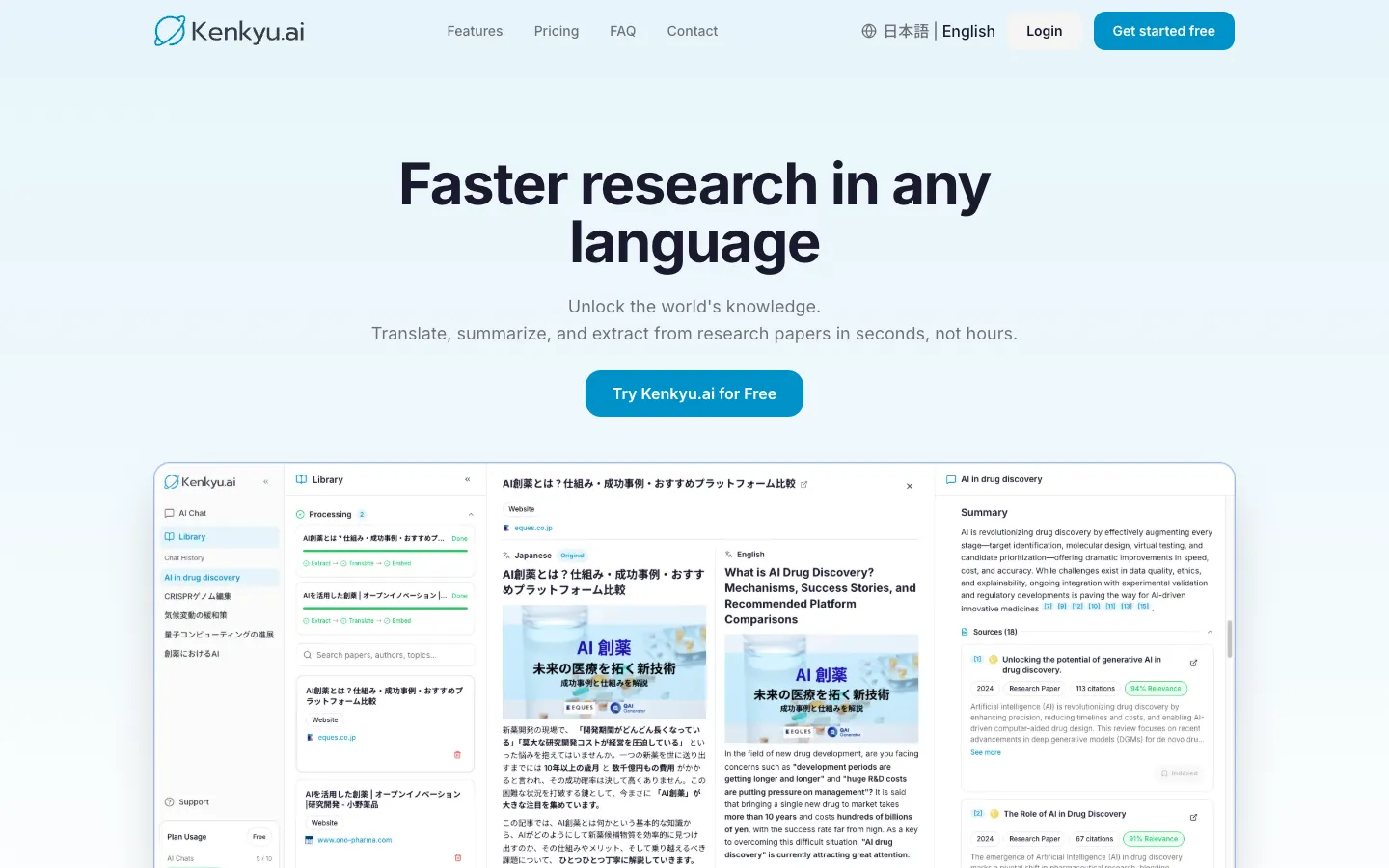
Score breakdown (0 to 5)
Search 3 · Coverage 4 · Synthesis 3 · Q&A 3 · PDF 3 · Translation 4 · Reference management 2 · Writing 0 · Data extraction 2 · Citation trust 4 · Ease 4 · Value 4 · Integrations 1
Kenkyu.ai is our top Anara alternative because it covers the two jobs Anara hands back to you: finding the papers and reading them across languages. It searches the same 200M+ paper index that powers Semantic Scholar, translates any paper into your native language with a side-by-side bilingual view, and answers your questions with citations that resolve to the exact source paragraph rather than just a document title. Anara waits for you to assemble a folder; Kenkyu.ai builds that folder for you out of the global literature, then helps you read it in the language you think in.
It is an editorial first pick rather than the highest raw score, and we are clear about why. On pure single-PDF reading, Anara and SciSpace edge ahead (both score a 5 on PDF analysis to Kenkyu.ai's 3). What neither offers is the combination Kenkyu.ai is built on: discovery plus native-language translation plus source-traceable citations, in one place, at a price most students can afford. If you only ever interrogate documents you already hold and you work only in English, Anara's reader is excellent. If you start most projects by needing to find the right work, often in another language, this is the better front end.
Key features
- Search across 200M+ papers (Semantic Scholar corpus) plus the web
- Native-language translation of full papers, with a bilingual reading view
- Cited answers that link to the specific source paragraph, not just a title
- Chat with uploaded PDFs
- Clean console available in English and Japanese
Strengths
Where Anara is a reading-and-collaboration tool, Kenkyu.ai's edge is putting search, translation, and grounded answers in one workflow, so you never leave to find a paper or paste it into a translator. Citations resolve to the source passage, which is why it earns a 4 on citation trust, the same trust level Anara earns for its own passage-level sourcing. The difference is reach: Kenkyu.ai brings that trust to literature you have not found yet, in languages you do not read. The free plan is built for testing without commitment, with unlimited search across the full index, 10 AI chats, and 10 uploads per month, and no card to start. Plus is roughly $8 per month (¥1,260), among the most affordable paid tiers on this list and well below Anara's Pro tier.
Weaknesses
Kenkyu.ai is a research and reading tool, not a writing suite, so it scores a 0 on drafting; if you want AI to produce manuscript prose, pair it with a dedicated writer. Reference management is light (you can save papers, but it is not a Zotero replacement), and there is no browser extension, Word plugin, or team-collaboration layer of the kind Anara offers, so it scores lower on integrations. It is also a newer brand than a Y Combinator-backed name like Anara, even though it runs on the same Semantic Scholar corpus many rivals share.
Price
Free, with unlimited search of 200M+ papers plus 10 AI chats and 10 uploads per month and no credit card. Plus is about $8 per month (¥1,260) with unlimited chat and uploads and larger file limits. Enterprise pricing is custom.
Best for
Multilingual researchers, graduate students, clinicians, and journalists who start by needing to find and understand papers, especially across Japanese and English, and want traceable citations without paying for a heavy suite.
2. Paperguide: the best value all-in-one alternative
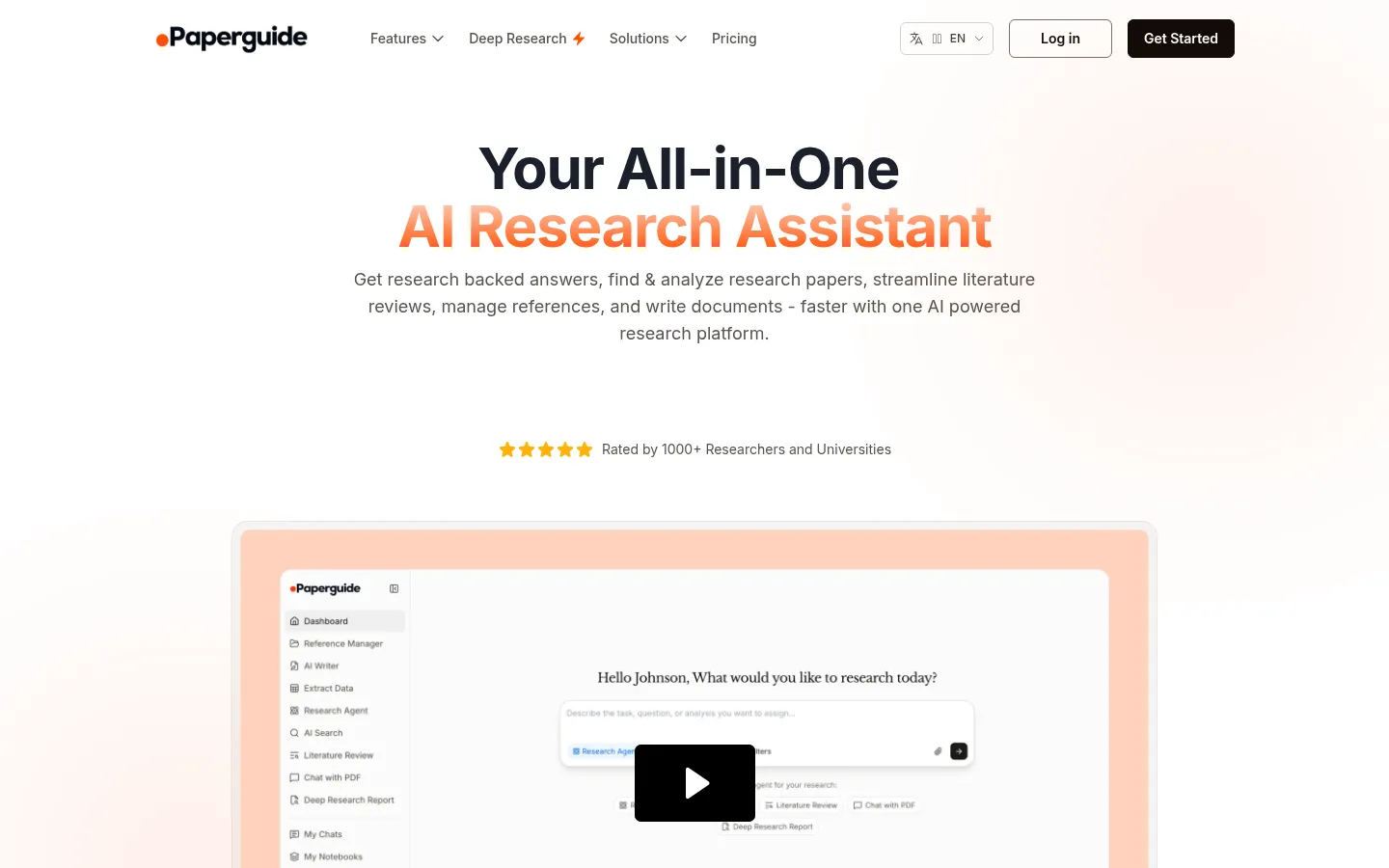
Score breakdown (0 to 5)
Search 3 · Coverage 4 · Synthesis 3 · Q&A 3 · PDF 3 · Translation 0 · Reference management 5 · Writing 3 · Data extraction 4 · Citation trust 3 · Ease 4 · Value 5 · Integrations 4
If Anara feels too narrow for the price, Paperguide is the obvious counter: it does the whole workflow Anara skips. Where Anara reads the documents you bring, Paperguide finds papers across a 200M+ index, runs a structured literature review, extracts data into tables, manages a full reference library, and drafts cited text, all in one tool. It is the only alternative here to score a 5 on value, because it pairs a real reference manager (1,000+ citation styles, broad import support) with AI research features at a fraction of the premium suites' cost.
Key features
- AI search across 200M+ papers with journal-quality signals (SJR, SNIP, quartiles)
- Full reference manager with 1,000+ styles and many import paths
- Structured, multi-step literature review with screening control
- Data extraction tables and multi-paper Chat with PDF
- "Original Text for Verification" to check AI claims against the source
Strengths
Budget-conscious researchers respond to the consolidation pitch: Paperguide holds 4.3 out of 5 across 85 AppSumo reviews, where one reviewer said it "completely replaced Afforai/Logically for me without any real downside," and G2 users describe getting "quick and customizable comparison of sources, within minutes instead of weeks of work." It surfaces journal-quality metrics throughout and exposes the underlying source text for any AI claim, which gives it real research-rigor signals at a low price. Crucially for an Anara switcher, it adds the discovery and reference-management layers Anara lacks.
Weaknesses
Paperguide sits in the budget, lifetime-deal tier rather than the premium-rigor tier, and that shows. Its AI drafts have been flagged by detectors such as GPTZero, its database is smaller than SciSpace's (200M versus 280M), and reviewers caution that you still need to double-check the papers it surfaces. It does not translate papers, so it is no better than Anara for non-English work, and its brand awareness is low, with growth leaning on deals and affiliates. On passage-level citation precision it is solid but does not quite match Anara's tight in-line sourcing.
Price
Free (1,000 credits per month, 20 searches per month, plus the reference manager). Plus is $12 per month and Pro $24 per month, with a 40% student discount and Enterprise custom.
Best for
Students and researchers on a budget who want one consolidated tool that takes them from discovery through reference management and writing, not just document chat.
3. SciSpace: the strongest single-PDF reading copilot
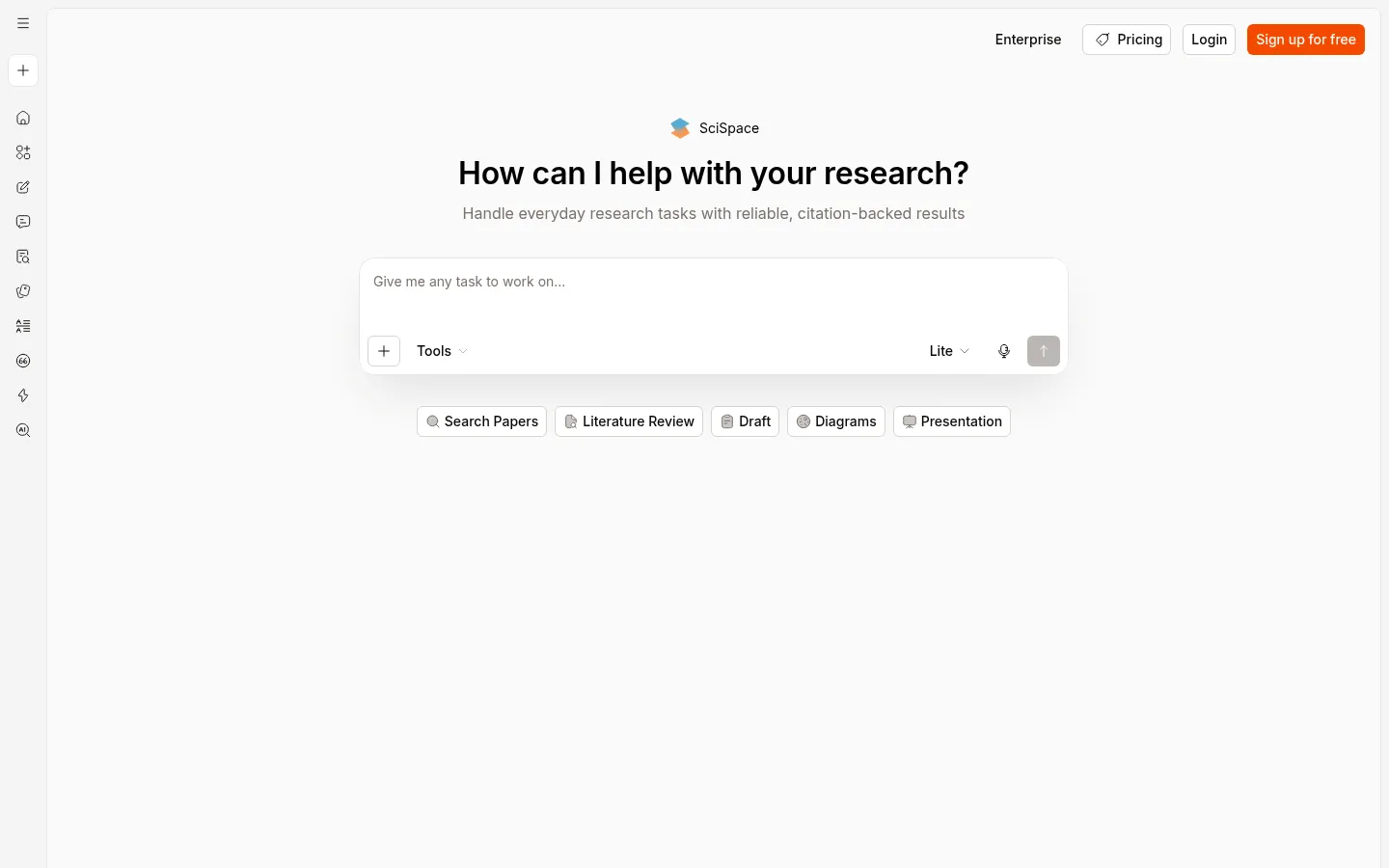
Score breakdown (0 to 5)
Search 3 · Coverage 5 · Synthesis 3 · Q&A 4 · PDF 5 · Translation 2 · Reference management 3 · Writing 3 · Data extraction 4 · Citation trust 3 · Ease 3 · Value 3 · Integrations 4
SciSpace is the alternative that meets Anara head-on at its own game, reading. Its Chat with PDF copilot lets you highlight any sentence and get a plain-language explanation with deep links back into the source, and on that specific job it matches Anara's 5 for document analysis. The difference is what surrounds it: SciSpace also searches a large literature index (280M+ claimed) and bundles a writer, paraphraser, and AI detector, so it reaches a little further into discovery than Anara does.
Key features
- Highlight-to-explain Chat with PDF with deep links into the source
- Large literature search index (280M+ claimed) with links to real articles
- Data extraction tables across papers
- AI Writer, paraphraser, and AI-detection tools
- Chrome extension, mobile app, and a ChatGPT plugin
Strengths
Reviewers single out the reading experience. One associate professor noted that SciSpace "provides access or links to actual articles that you can then search, to ensure that it's not hallucinating false, nonexistent papers," and Professor David Stuckler rated it "8 out of 10" overall, calling it "one of the best for chatting with a PDF." It holds a 4.3 out of 5 on Capterra across 79 reviews. For an Anara user, the appeal is keeping the highlight-and-explain reading flow while gaining a search index Anara does not have.
Weaknesses
The loudest complaint is opaque credit consumption: users report burning credits faster than expected and being pushed to upgrade, with one professor leaving a one-star review after a refund was refused over consumed credits. Its discovery returns a "partial set" rather than exhaustive recall (Stuckler still recommends Google Scholar for finding papers), coverage thins on hard sciences and non-English work, and reviewers find the interface busy. Citation reliability is "generally good, occasionally off" rather than airtight, so on citation precision it trails Anara. If those credit walls frustrate you, our SciSpace alternatives guide compares tools that bill more predictably.
Price
Free tier available. Premium is $12 per month (annual), Advanced $70 per month, and Max $160 per month, all credit-based, with Enterprise custom.
Best for
Graduate students and postdocs who want Anara-grade single-paper reading plus a built-in search index and light writing in the same workspace.
4. NotebookLM: the best free source-grounded alternative
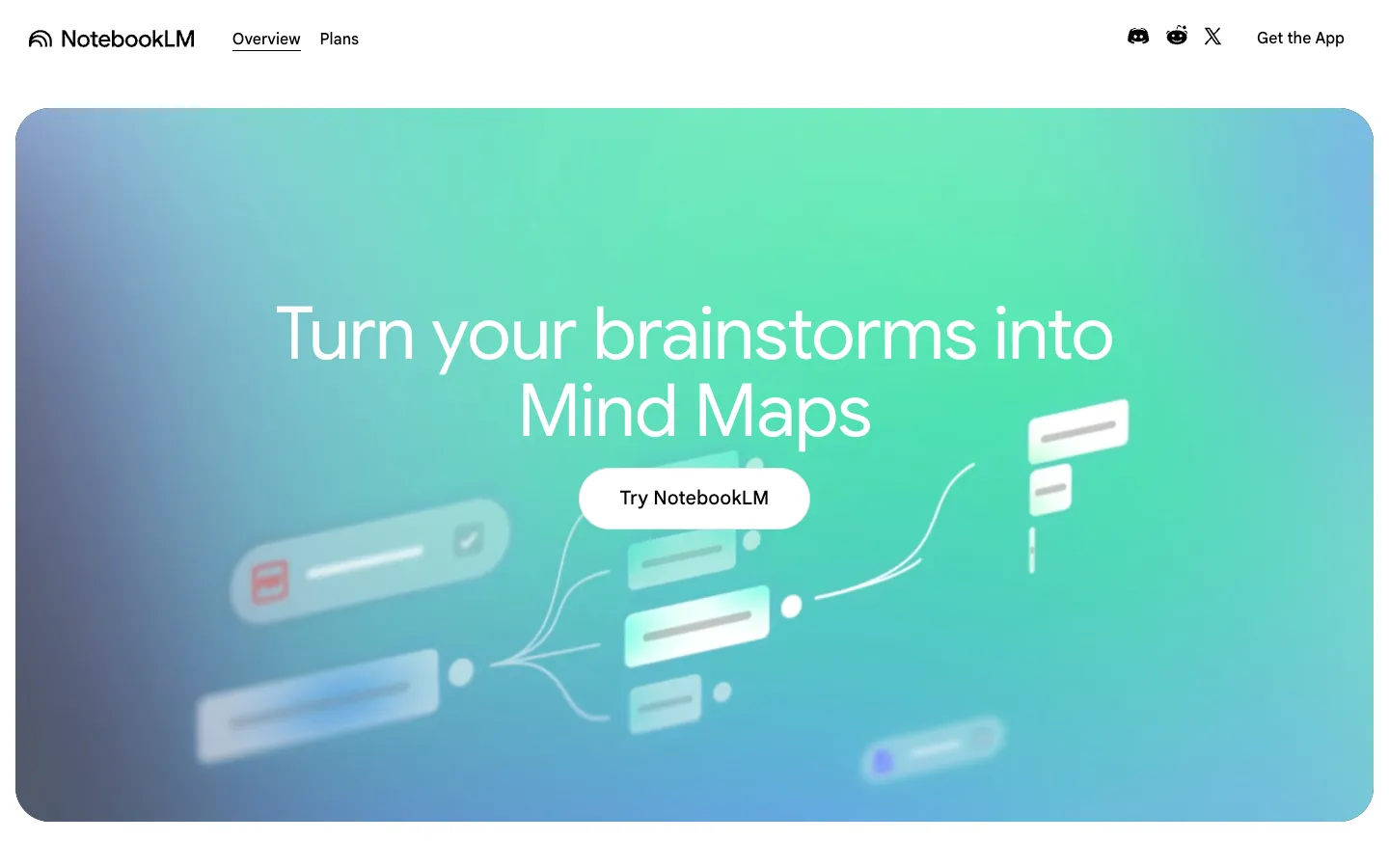
Score breakdown (0 to 5)
Search 0 · Coverage 0 · Synthesis 4 · Q&A 4 · PDF 5 · Translation 1 · Reference management 1 · Writing 3 · Data extraction 3 · Citation trust 5 · Ease 5 · Value 4 · Integrations 2
NotebookLM is the closest free analog to Anara's core idea: it works only with the sources you upload and grounds every answer in them, with clickable citations to the exact passage. For researchers drawn to Anara's trustworthy, source-locked reading but unwilling to pay, Google's tool delivers much of that for nothing, and adds Studio outputs (podcast-style Audio Overviews, mind maps, quizzes) that Anara has no equivalent for.
Key features
- Strict source-grounding with clickable in-line passage citations
- Audio Overviews, mind maps, quizzes, and other Studio outputs
- Strong multi-document Q&A and synthesis
- Clean, near-effortless interface (it scores a 5 on ease of use)
- Free tier with 50 sources per notebook
Strengths
For making sense of material you already have, NotebookLM is excellent and genuinely free. It scores a 5 on citation trust because every answer is tied to your sources, an independent measure put its hallucination rate near 13% against roughly 40% for ChatGPT, and it holds a 4.8 out of 5 on G2. One widely upvoted researcher reported cutting research time from "2 to 3 hours" to "30 to 40 minutes with better clarity." It matches Anara's passage-grounded reading and beats it on price and study outputs.
Weaknesses
Like Anara, NotebookLM cannot find papers: it has no search and no corpus (both score 0), so you supply every source. It also lacks Anara's reference-manager connectors (Zotero, Mendeley) and team collaboration, the free notebook caps at 50 sources, and accuracy can degrade as you near that cap. Export is limited, there is no real API, and translation is minimal, so it is a weak fit for non-English papers on its own. In short, it shares Anara's discovery blind spot. For ways to add search and translation to this workflow, see our NotebookLM alternatives guide.
Price
Free (50 sources per notebook). Plus is about $7.99 per month and Pro about $19.99 per month, with higher Google tiers above that.
Best for
Researchers who like Anara's source-grounded chat but want it free, with study outputs, and do not need discovery, connectors, or translation.
5. Logically: the cheap all-in-one cite-and-write workspace
Score breakdown (0 to 5)
Search 3 · Coverage 3 · Synthesis 3 · Q&A 3 · PDF 4 · Translation 1 · Reference management 4 · Writing 4 · Data extraction 3 · Citation trust 3 · Ease 3 · Value 4 · Integrations 3
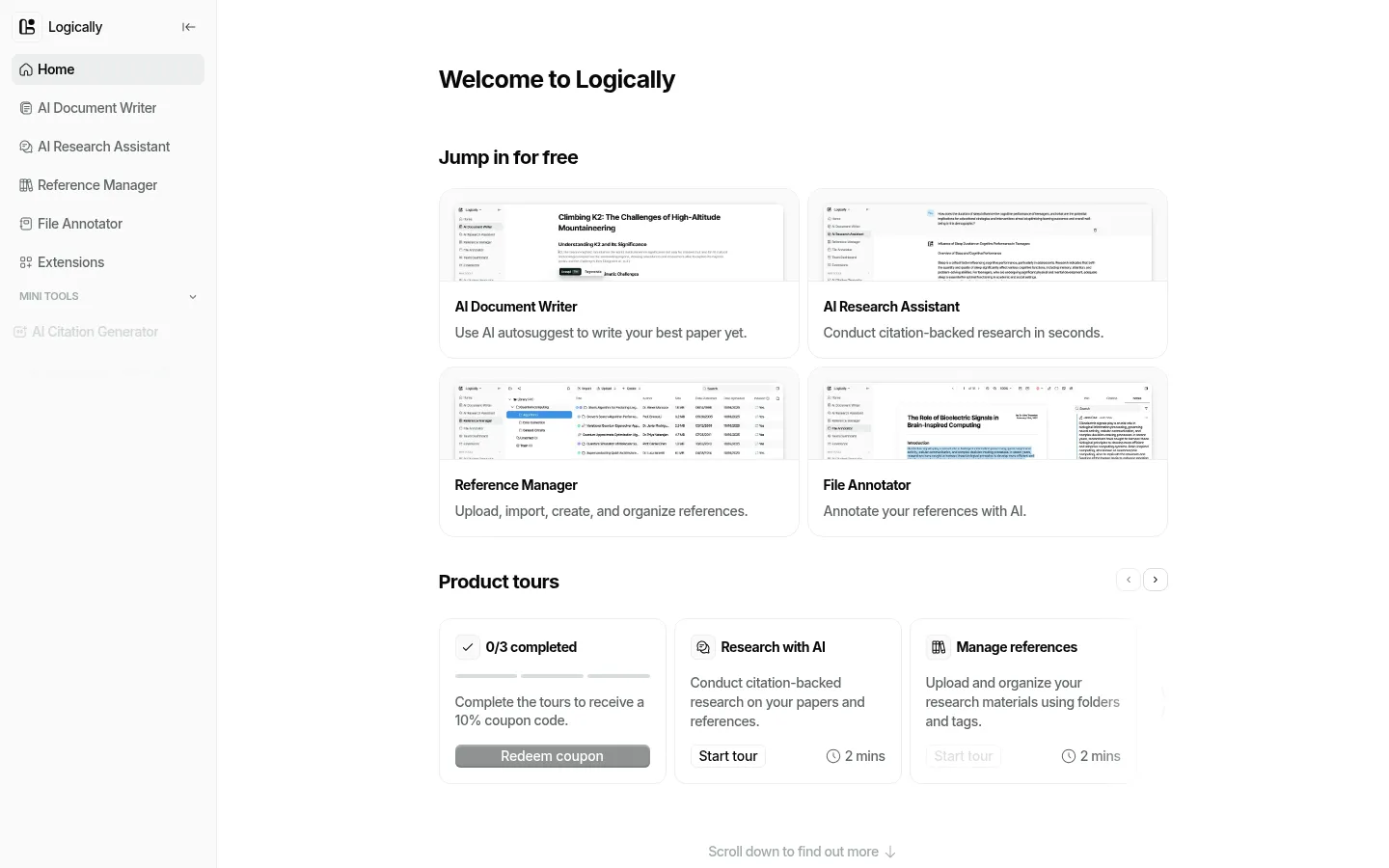
Logically (the rebrand of Afforai) is a consolidation play that overlaps with Anara on reading and annotation while adding the reference manager and writer Anara does not fully offer. Its standout is three research modes in one assistant: a Semantic Scholar mode that scans 200M+ papers, a Google mode for the open web, and a document-retrieval mode that chats with your uploaded library, the last of which is the most direct match to Anara's Chat with Folder. It strengthens annotation and writing where Anara is thinner, all at $12 per month.
Key features
- Three AI research modes: Semantic Scholar 200M+, Google web, and your own documents
- File Annotator with text and "Area Highlight" (AI reads graphs and images)
- Reference manager with 10,000+ citation styles and broad import support
- Document Writer with cite-from-library and automatic bibliography
- Browser extensions and shared libraries for collaboration
Strengths
A PhD power user on Logically's community ranked it above Anara, Petal, SciSpace, and AnswerThis for chatting across "many papers at the same time" and for linking annotations directly to writing. It holds a 4.2 out of 5 across 454 AppSumo reviews, with praise for ease of use, its citation-backed Google mode, and handling of large or multilingual documents. For an Anara switcher, the draw is a document-chat experience plus a real reference manager and writer in one cheap subscription.
Weaknesses
The serious caveat is trust history: the Afforai-to-Logically transition came with documented lifetime-deal account revocations that left early backers feeling burned, a reputational risk worth knowing before you commit. Accuracy and hallucination complaints persist despite the citation framing (one review was titled "Unreliable for summaries and research"), file uploads can be slow, and its discovery depth is weaker than Paperguide's or a dedicated search tool's. Its citation precision and reading polish do not match Anara's tight passage-level sourcing.
Price
Free (5 AI actions per day, no credit card). Unlimited is $12 per user per month (billed yearly), with an extra 50% student discount and tiered team and institution pricing.
Best for
Students and researchers who want Anara-style multi-document chat plus a reference manager, annotator, and writer in one low-cost workspace, and who are comfortable with a tool that has had trust wobbles.
6. Paperpal: the academic editing and submission specialist
Score breakdown (0 to 5)
Search 2 · Coverage 3 · Synthesis 2 · Q&A 2 · PDF 3 · Translation 2 · Reference management 3 · Writing 4 · Data extraction 0 · Citation trust 4 · Ease 3 · Value 3 · Integrations 5
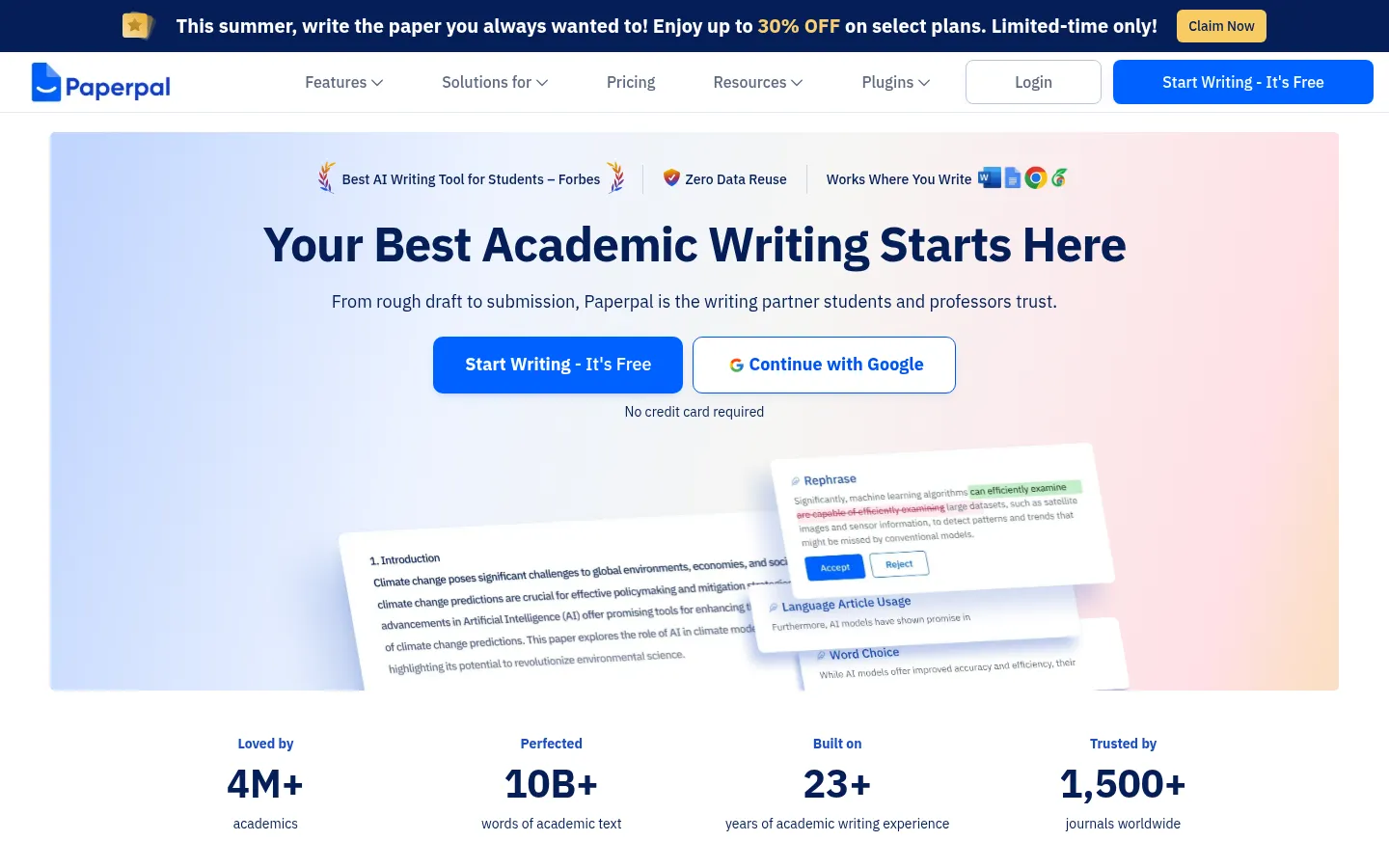
Paperpal is a different kind of alternative: if what you actually liked about Anara was the writing and citation support, Paperpal does that part far more seriously. It is an academic writing, editing, and submission-readiness suite built on academic prose, with academic-specific grammar and language editing, paraphrasing, plagiarism and AI detection, and 30+ journal pre-submission checks. It also chats with up to 10 PDFs in 50+ languages and searches across 250M+ articles for citing, so it covers a sliver of the reading Anara does, while going much deeper on output.
Key features
- Academic-trained grammar, language, and style editing
- AI Paraphraser, plagiarism checker, and AI detector
- Research & Cite across 250M+ articles, 10,000+ citation styles
- Chat with up to 10 PDFs in 50+ languages
- Works in MS Word, Google Docs, Overleaf, Chrome, and the web
Strengths
Editors and reviewers rate Paperpal's academic editing above general checkers: it "catches grammar mistakes that other grammar checkers miss" and gives "subject-specific language suggestions," and it is especially valued by non-native English researchers for making text "sound professional and academic" without flattening meaning the way some paraphrasers do. Its integration footprint is the broadest here (it scores a 5), so it meets you inside Word, Docs, and Overleaf. Privacy is a genuine strength, with no training on your data and FERPA, ISO 27001, GDPR, and HIPAA certifications.
Weaknesses
Paperpal is a writing tool first, so it is not a reading or discovery workspace the way Anara is: it has no data extraction, thin synthesis and Q&A, and only light PDF chat. It can struggle with specialized jargon, it is English-primary, and its aggregate rating sits around a "fairly average" 3.5 to 3.7, with the usual category gripes about billing and value past the free tier. If you want to interrogate a folder of papers, Anara or NotebookLM does that better; Paperpal earns its place only on the writing and submission side.
Price
Free (200 language suggestions per month, 5 AI uses per day, 7,000-word plagiarism checks). Prime is about $11.58 per month on the annual plan ($25 monthly), with institutional plans custom.
Best for
Non-native-English researchers polishing a manuscript to submission-ready, who want academic editing and integrity checks rather than a document-chat workspace.
7. Liner: accurate, every-line-cited search and writing
Score breakdown (0 to 5)
Search 4 · Coverage 4 · Synthesis 3 · Q&A 4 · PDF 3 · Translation 0 · Reference management 1 · Writing 3 · Data extraction 3 · Citation trust 4 · Ease 3 · Value 3 · Integrations 2
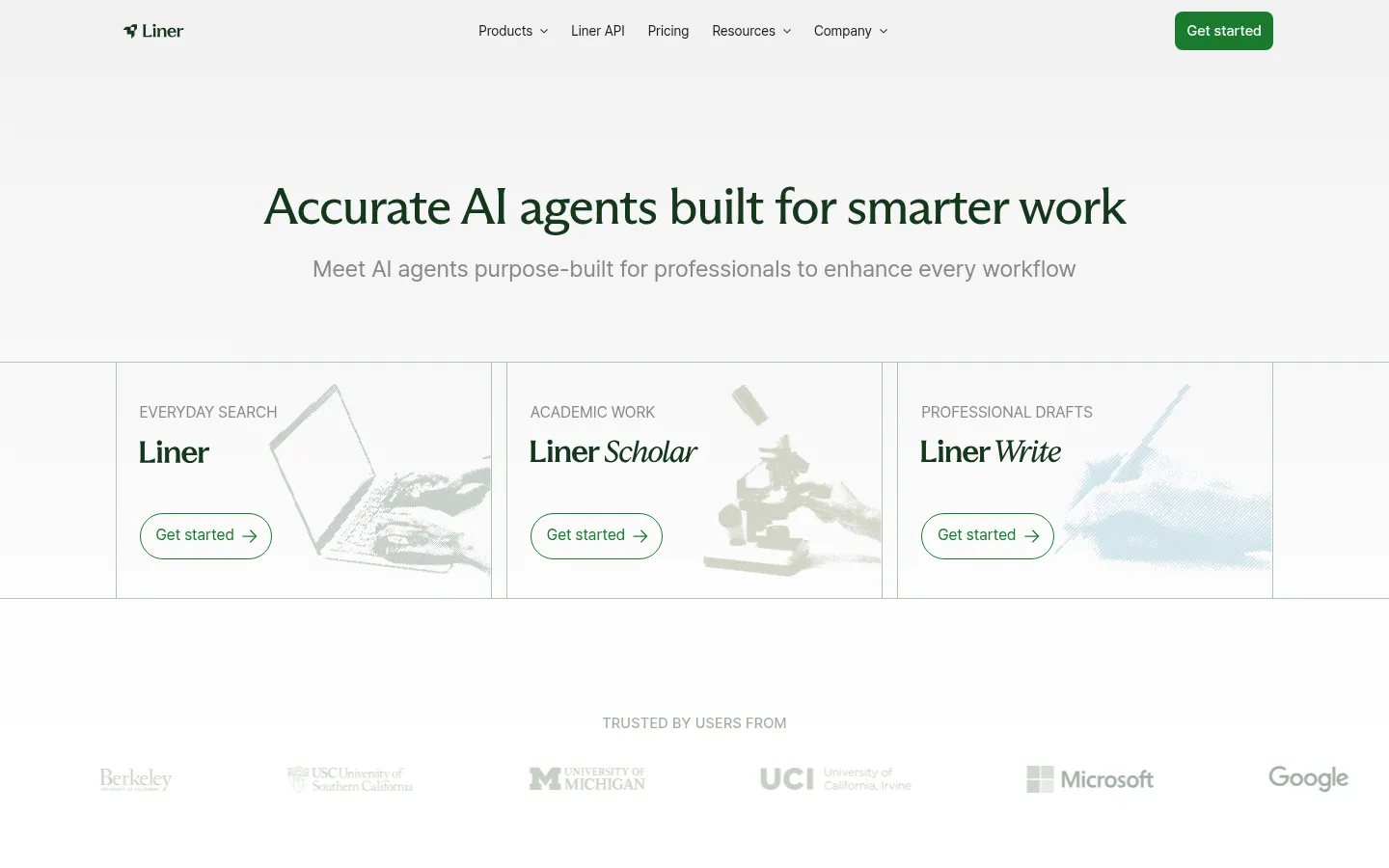
Liner approaches the gap from the discovery side. Where Anara waits for your uploads, Liner is a Perplexity-style answer engine repositioned for students and researchers, with a Scholar agent that searches papers and a writing tool attached. It cites line by line and leans on a strong factual-accuracy benchmark, so it offers the kind of source-trust Anara users expect, but applied to search across the literature rather than to a folder you assembled.
Key features
- AI search with line-by-line citations on answers
- Large claimed corpus (480M+ papers)
- Liner Scholar agents for literature review and comparison tables
- Built-in writing assistant
- Web, mobile, and browser extension (Scholar and Write are desktop-only)
Strengths
Liner's repeatable selling point is accurate, verifiable, every-line-cited search at a low price. It markets a 95.3% score on OpenAI's SimpleQA factual-accuracy test, reports 13M+ users, and draws roughly 83% positive reviews praising accuracy and research speed, with reviewers noting it "outperform[s] other leading AI research tools like Perplexity" on accuracy. Folding search, a scholar agent, and writing into one $14.99 subscription makes it a credible budget all-rounder that, unlike Anara, finds papers for you.
Weaknesses
The reputation risk is real: billing, cancellation, and refund complaints are the single most prominent theme in Liner's reviews, and accuracy caveats note it can over-generalize, so verification is still wise. The free tier is thin (credit-limited and ad-supported), the mobile app draws bug reports, and Scholar and Write are desktop-only. It also lacks Anara's polished folder-reading and passage-highlight experience and its reference-management depth, so it is a discovery-and-writing alternative rather than a reading-workspace replacement.
Price
Free (100 credits per month, ads). Pro is $14.99 per month (annual) and Max $29.99 per month, with Team and Enterprise tiers above.
Best for
Students and researchers who want accurate, heavily cited search and light writing in one cheap subscription, and who care more about discovery than folder-based reading.
Anara (baseline): collaborative, cited chat across your own documents
Score breakdown (0 to 5)
Search 2 · Coverage 1 · Synthesis 3 · Q&A 4 · PDF 5 · Translation 1 · Reference management 3 · Writing 3 · Data extraction 2 · Citation trust 4 · Ease 4 · Value 3 · Integrations 4
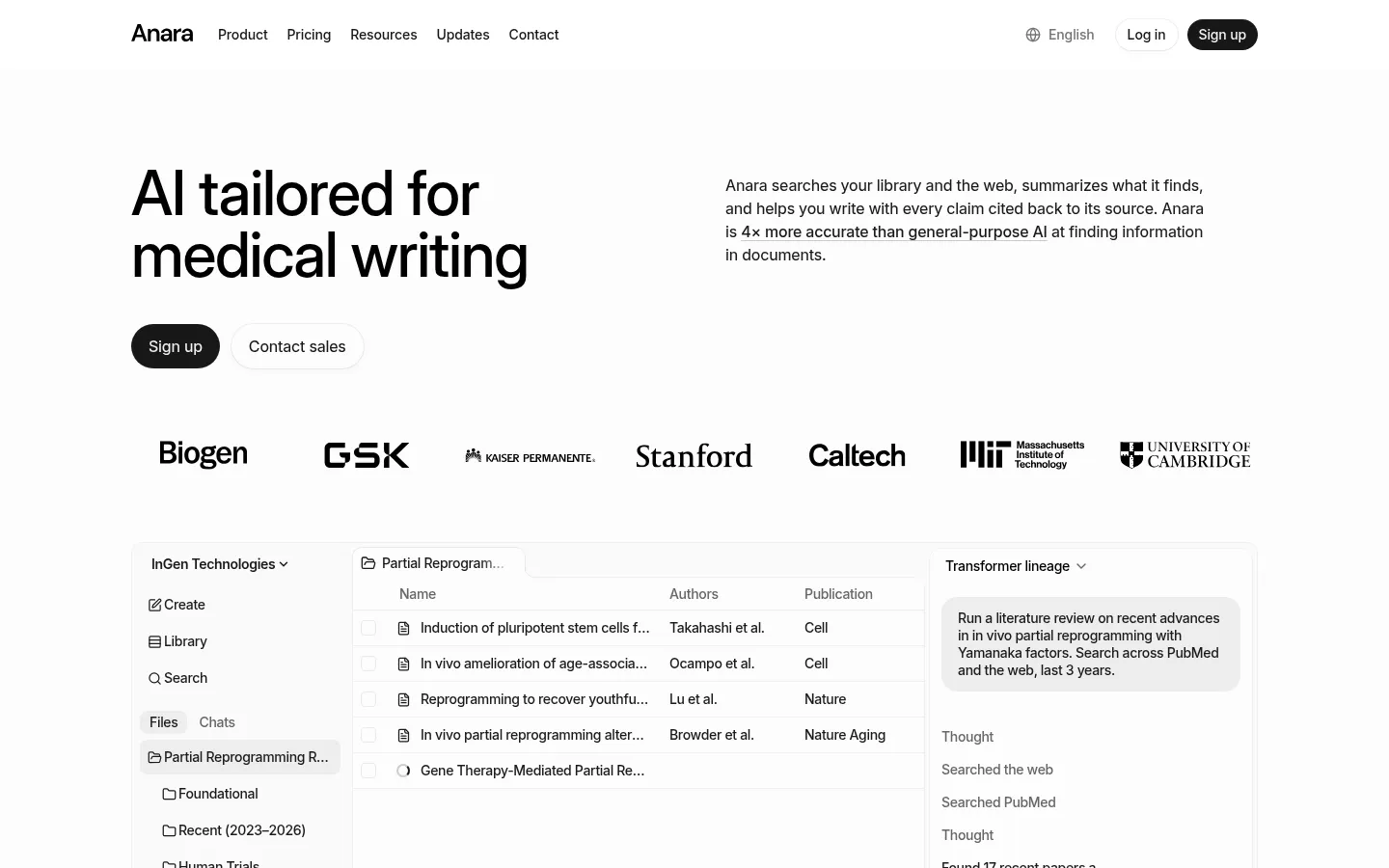
Here is the tool you are comparing against, scored on the same rubric. Anara (formerly Unriddle) is a collaborative workspace for reading and chatting with documents you upload, and on that job it is genuinely strong: its Chat with Folder lets a team query an entire library at once, with every answer cited to a passage, and it scores a 5 on document reading, the top of this list. We are not talking you out of Anara so much as showing where its scores leave room for an alternative.
Key features
- Chat with Folder across an entire uploaded library
- Accurate passage-level citations on every answer
- Handles PDFs, video, audio, and images in one workspace
- Model choice (GPT, Claude, Gemini) and real-time collaboration
- Connectors for Zotero, Mendeley, Drive, Notion, and OneDrive
Strengths
Anara's signature strength, and the reason it is the toughest rival on this page, is citation precision: an editorial review found its citations "consistently accurate and contextually relevant," noting it "pulls references from the correct documents and highlights relevant sections." Its multi-format support and model choice make it versatile, real-time collaboration is genuinely useful for teams, and privacy is a real selling point (no training on your data, GDPR for all tiers, SOC2 and ISO27001 at enterprise). The company reports 3M+ users and 78% citing significant time savings, with usage at Stanford, Johns Hopkins, and GSK.
Weaknesses
The defining limit is that Anara is not a discovery engine: it has no native corpus, so it only reads what you bring (search and coverage score 2 and 1), and translation is minimal, so cross-language reading is a separate step. Reviewers find its explanations "too general" for niche or technical work, and it attracts pointed skepticism over aggressive affiliate and influencer marketing, with Reddit threads questioning the hype and at least one user reporting an unexpected ANARA INC. charge, so watch the free-tier caps and billing. Its free tier is also restrictive (2,000 words per day, 5 uploads per day) and its paid tiers are considered steep for students and underfunded teams.
Price
Free (2,000 words per day, 5 uploads per day). Plus is about $10 per month, Pro about $20 per month, and Max about $167 per month, with Enterprise custom.
Best for
Individuals and teams who need to read, annotate, and collaboratively query their own document libraries with reliable citations, and whose work does not depend on finding or translating new literature.
How we scored these Anara alternatives
Every tool here is scored once, on the same 13-point rubric, on a 0 to 5 scale where 0 means the capability is absent or unusable and 5 means best in class. The criteria are search and discovery, corpus coverage, synthesis and summarization, conversational Q&A, document and PDF analysis, translation, reference management and export, writing and drafting, data extraction, citation integrity, ease of use, value, and integrations. Scores are grounded in documented features, official pricing, and real user sentiment from review sites and research communities, not vendor marketing. Vendor-reported figures such as corpus sizes and accuracy percentages are treated conservatively and labeled as claims.
For an Anara alternatives page, we weight the criteria toward what defines Anara's job and the gaps around it: document and PDF analysis, citation integrity, synthesis, and writing carry the most weight, with reference management, integrations, and value close behind. We then rank the field by that weighted result, with Anara shown as the baseline and Kenkyu.ai named Editor's pick for the discovery-and-translation job Anara leaves to the user. On single-PDF reading, Anara and SciSpace genuinely lead; the full per-criterion scores in the table above let you re-weight for your own priorities. For the wider category, our guide to the best AI academic research tools and our best academic paper search tools roundup go deeper on discovery.

Written by
Timothy Andersen, Kenkyu.ai Founder