Most people do not actually want to replace Google Scholar. They want what it already does (free, comprehensive, citation-rich search) plus the three things it has never done: summarize a paper, synthesize an answer across the literature, and translate work written in another language. That is the real reason people search for a Google Scholar alternative. Scholar finds everything and reads nothing, so the question is which tool keeps the coverage while adding an AI layer you can trust on top.
The trust part is where this gets tricky, because the moment you add AI to academic search, fabrication becomes possible. Google Scholar never invents a reference; it returns real links or nothing. General chatbots are the opposite, with peer-reviewed studies finding GPT-4 produces false citations more than 20% of the time and a GPT-4o study putting the share of fake or error-laden references as high as 56%. A good Google Scholar alternative has to add answers without giving up Scholar's one unbeatable quality: every result is a real paper. So our ranking weighs citation integrity as heavily as search and coverage.
Our top pick is Kenkyu.ai, because it is the closest thing to "Google Scholar plus an AI that reads and translates for you." It searches the same 200M+ paper corpus that underpins much of this field, then lets you read any result in your native language and ask questions answered with citations that link to the exact source paragraph. If you only ever search and read in English, the free incumbents further down may be all you need, and we say exactly where. If your literature crosses languages, Kenkyu.ai is the upgrade that does what Scholar leaves undone.
Every tool was scored 0 to 5 on the same 13-point rubric, weighted here toward search, coverage, and citation integrity, with scores grounded in documented features, pricing, and real user sentiment rather than marketing copy. Higher is better.
What is Google Scholar?
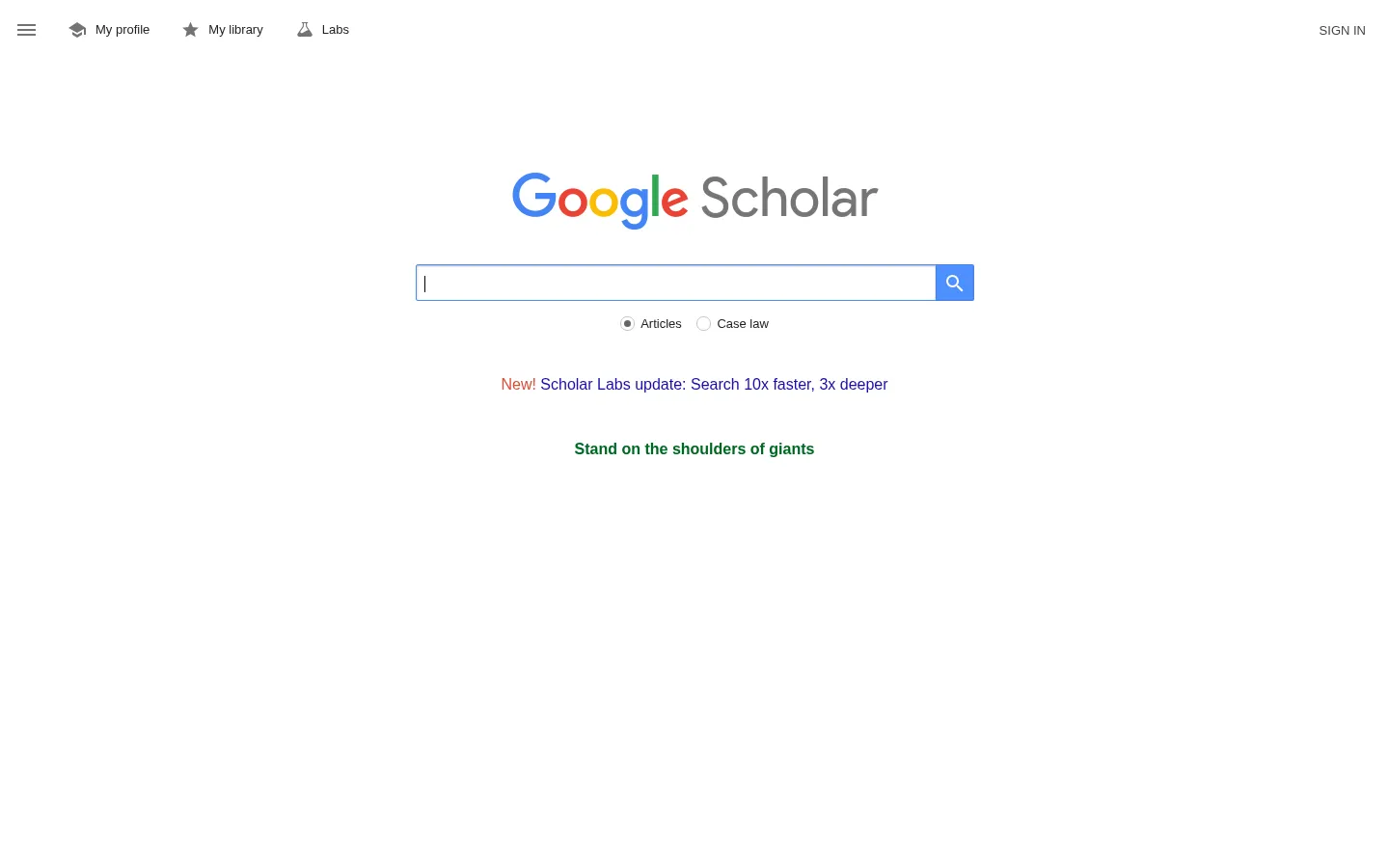
Google Scholar is the free academic search engine Google launched in 2004, and the default starting point for most literature searches. It crawls the web for scholarly content (journal and conference papers, theses, books, preprints, technical reports, patents, and court opinions) and lets you search across all of it from one box, with no account required. Its tagline, "Stand on the shoulders of giants," sits above a search bar that works like ordinary Google, which is a large part of why it became universal.
Two things make it hard to displace. First, coverage: third-party estimates put its index around 390M+ documents, the broadest free net in academic search, and it is unusually good at surfacing gray literature like conference proceedings that curated databases under-index. Second, its citation layer: "Cited by," "Related articles," and "All versions" make backward and forward citation chaining effortless, and free Scholar Profiles track h-index and citation counts. Crucially, it returns only real papers, so there is no fabrication risk.
What Google Scholar is not is an assistant. It has no synthesis, no summaries, no chat, and no translation. Its filtering is weak (you cannot reliably limit to peer-reviewed or full-text), its results are opaque and vary by location and history, it caps each query at 1,000 results, and it offers no public API. Those gaps, not its search, are what every alternative below is built to fill.
At a glance: the best Google Scholar alternatives compared
Scores are 0 to 5 (higher is better). Citation trust is our shorthand for citation integrity: whether results trace to real, correctly linked sources. Google Scholar is shown last as the baseline you are measuring against.
| Rank | Tool | Search | Coverage | Synthesis | Citation trust | Value | Price | Best for |
|---|---|---|---|---|---|---|---|---|
| Editor's pick | Kenkyu.ai | 3 | 4 | 3 | 4 | 4 | Free; Plus ~$8/mo | Scholar-scale search plus AI answers and native-language reading |
| 2 | Paperguide | 3 | 4 | 3 | 3 | 5 | Free; Plus $12/mo | An affordable all-in-one upgrade with journal-quality signals |
| 3 | Undermind | 5 | 4 | 3 | 5 | 4 | Free; Pro $16/mo | The deep search that finds what a Scholar query misses |
| 4 | SciSpace | 3 | 5 | 3 | 3 | 3 | Free; Premium $12/mo | A huge index with a read-and-explain copilot |
| 5 | Consensus | 4 | 4 | 3 | 4 | 4 | Free; Pro $10/mo | Evidence-first answers to yes or no questions |
| 6 | Elicit | 3 | 4 | 4 | 5 | 3 | Free; Plus ~$10/mo | Screening and extraction at systematic-review scale |
| 7 | Semantic Scholar | 4 | 4 | 1 | 5 | 5 | Free | Smarter free discovery with TLDRs and a citation graph |
| 8 | ResearchRabbit | 4 | 4 | 0 | 4 | 5 | Free; RR+ $10/mo | Visual citation-network mapping from a seed paper |
| 9 | Google Scholar | 4 | 5 | 0 | 5 | 5 | Free | The broadest free first-pass discovery and citation chaining |
The one-line verdict on Kenkyu.ai: multilingual search across 200M+ papers, native-language translation, and answers you can trace back to the source paragraph, all in one tool with a free plan that needs no credit card.
Why look for a Google Scholar alternative?
People rarely leave Google Scholar because the search is bad. They leave because of what happens after the search. The complaints cluster into three jobs Scholar does not do.
The first is reading and synthesis. A Scholar search returns a ranked list of links and stops there. It will not summarize a paper, pull the key finding out of a dense methods section, or tell you what the literature as a whole concludes about your question. For that you need a tool with an AI layer, and the strongest ones here (Consensus, Elicit, Undermind, and Kenkyu.ai) read across many papers and return a synthesized answer instead of a link list.
The second is language. Scholar indexes work in many languages but ranks English-centrically and offers no translation, so the most relevant paper for your question can land in front of you in a language you cannot read. This is the gap our top pick is built around: search across languages, then read the result in your own. The third is rigor and control: Scholar's results are opaque, location-dependent, and unreproducible, which is why methodologists consider it unfit as the primary search for a systematic review. Tools like Elicit and Undermind add the screening, traceability, and depth that formal reviews require. The rest of this guide ranks all nine alternatives, explains the score behind each, and concedes plainly where Google Scholar still wins.
1. Kenkyu.ai, Editor's pick: Scholar-scale search plus AI answers in your language
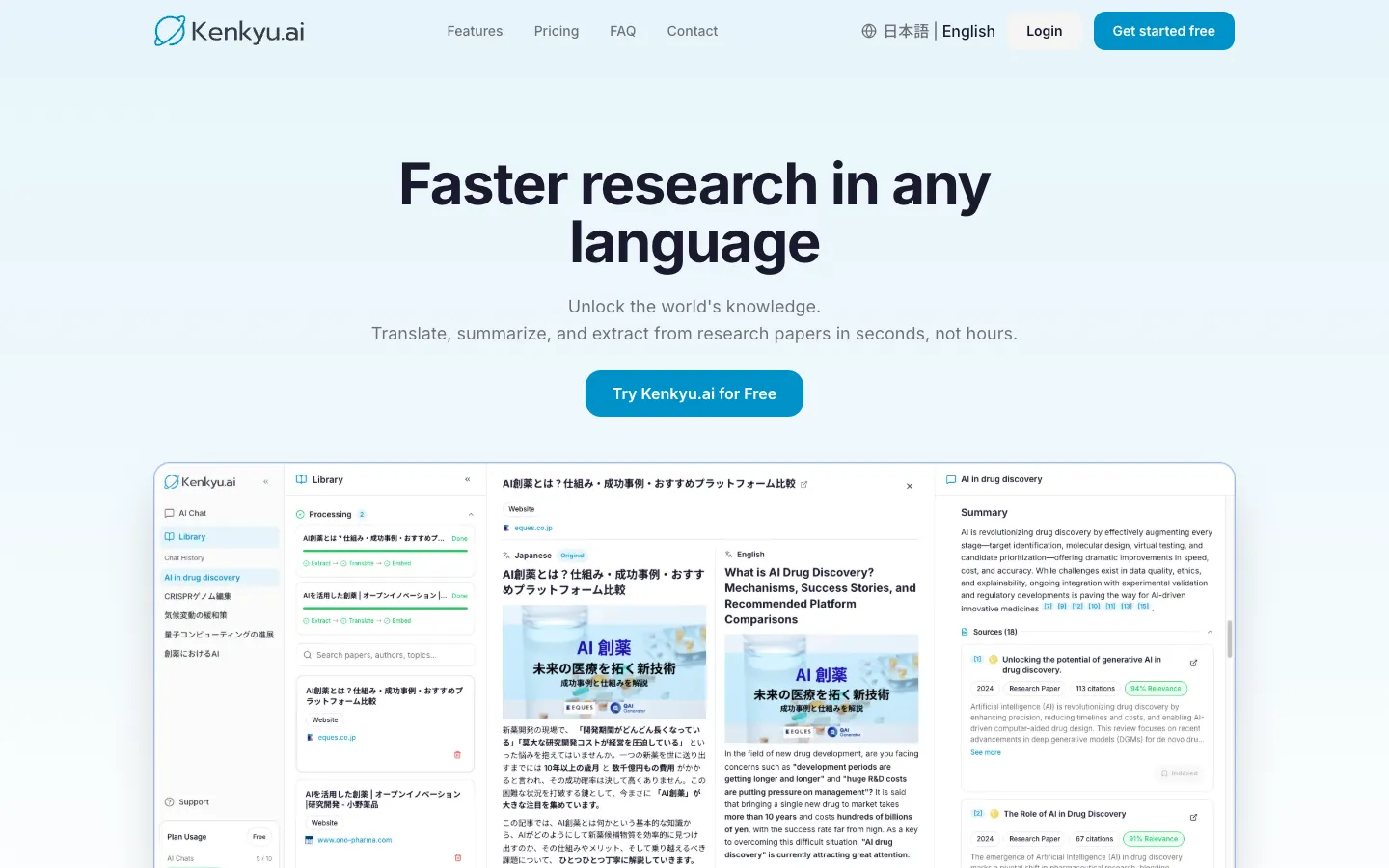
Score breakdown (0 to 5)
Search 3 · Coverage 4 · Synthesis 3 · Q&A 3 · PDF 3 · Translation 4 · Data extraction 2 · Citation trust 4 · Ease 4 · Value 4
Kenkyu.ai is our top pick as a Google Scholar alternative because it is the upgrade that keeps the part of Scholar you rely on and adds the parts it lacks. It searches the same 200M+ paper index that backs Semantic Scholar (the corpus much of this category is built on), then layers on the two things Scholar has never offered: it translates any paper into your native language, and it answers your questions with citations that link to the exact source paragraph. For the large and growing number of researchers whose key literature is not in English, that turns a foreign-language search result into something you can actually read and cite.
We are clear-eyed about why this is an editorial pick rather than the highest raw search score. On pure free breadth, Google Scholar still casts a wider net, and on deep recall Undermind digs further. Kenkyu.ai scores a solid 3 on search, not a 5. What it owns is the combination Scholar cannot match: search, native-language translation, and source-traceable answers in one workflow. If your work never leaves English and you only need to find and chain papers, the free incumbents below may be enough. If you read across languages, or you want to find a paper and immediately understand and trust it, start here.
Key features
- Search across 200M+ papers (Semantic Scholar corpus) plus the web
- Native-language translation of full papers, with a bilingual reading view
- Cited answers that trace back to the specific source paragraph, not just a paper title
- Chat with uploaded PDFs
- Clean console available in English and Japanese
Strengths
Kenkyu.ai closes the gap Google Scholar opens: it finds the paper and then helps you read it. From any result you are one step from a full translation and a grounded answer, which removes the copy-paste shuffle between a search engine, a translator like DeepL, and a chatbot. Because every answer resolves to the source passage, verification is fast, and that grounding is the reason it scores a 4 on citation trust where general chatbots score a 1. The free plan is built for trying the tool with no friction: search across the full index is unlimited, with 10 AI chats and 10 uploads per month and no credit card to start.
Weaknesses
Kenkyu.ai is a discovery and reading tool, not a writing suite, so it scores a 0 on drafting; pair it with a dedicated writing tool if you want AI to draft your manuscript. Its raw search depth is good rather than best in class (a 3), so power users running exhaustive systematic searches will still want a deep-recall tool alongside it. Reference management is light (you can save papers, but it is not a full Zotero replacement), and unlike Scholar it has no free author profiles or citation-metric tracking. It is also a newer name than the Google-backed incumbent, though it searches the same corpus much of the field relies on.
Price
Free (unlimited search of 200M+ papers, plus 10 AI chats and 10 uploads per month, no credit card). Plus is about $8 per month (¥1,260), with unlimited chat and uploads and larger file limits. Enterprise pricing is custom. Like most tools here it nudges you toward upgrading, but Plus is among the most reasonably priced paid tiers in this comparison.
Best for
Multilingual researchers, graduate students, clinicians, and journalists who want Google Scholar's breadth plus the ability to read and verify what they find across languages, especially Japanese and English.
2. Paperguide: the affordable all-in-one upgrade
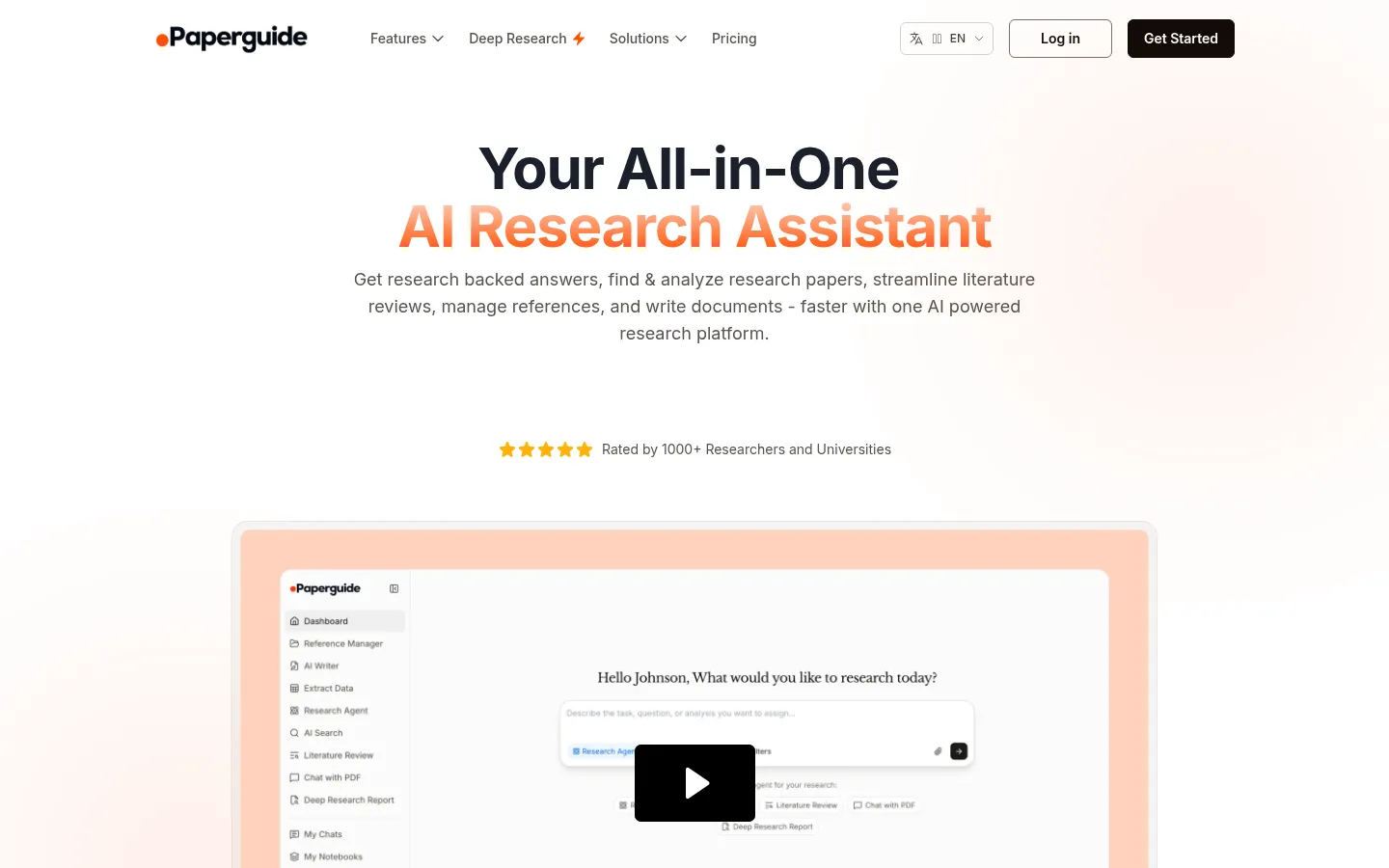
Score breakdown (0 to 5)
Search 3 · Coverage 4 · Synthesis 3 · Q&A 3 · PDF 3 · Translation 0 · Data extraction 4 · Citation trust 3 · Ease 4 · Value 5
Paperguide tops the weighted ranking among the alternatives because it answers the most common reason people leave Google Scholar (the lack of any layer above search) with the widest single upgrade at the lowest price. Where Scholar hands you a ranked list and stops, Paperguide wraps a 200M+ paper search in journal-quality signals (SJR, SNIP, and quartiles), a reference manager, AI summaries, data extraction, and a writer. It is the only tool in this comparison to score a 5 on value.
Key features
- AI search across 200M+ papers with journal-quality signals (SJR, SNIP, quartiles)
- Full reference manager with 1,000+ citation styles and broad import support
- Structured, multi-step literature review with screening control
- Data extraction and multi-paper Chat with PDF
- "Original Text for Verification" to check AI claims against the source
Strengths
Paperguide's appeal is breadth-for-the-money, which lands with budget-conscious researchers: it holds 4.3 out of 5 across 85 AppSumo reviews, and G2 reviewers describe getting "quick and customizable comparison of sources, within minutes instead of weeks of work." It also fixes one specific Scholar weakness directly, surfacing the journal-quality metrics Scholar omits, and its "Original Text for Verification" view lets you check an AI claim against the underlying source.
Weaknesses
Paperguide sits in the budget, lifetime-deal tier rather than the premium research-rigor tier, and that shows. Its database is smaller than SciSpace's (200M versus a claimed 280M), reviewers note you still need to double-check the papers it surfaces, and its AI drafts have been flagged by detectors such as GPTZero. It also has no translation, so non-English papers are still a separate problem. Brand awareness is low and growth has leaned on deals and affiliates, which skews some reviews toward deal-buyers rather than long-term researchers.
Price
Free (1,000 credits per month, 20 searches per month, plus the reference manager). Plus is $12 per month and Pro $24 per month, with a 40% student discount and Enterprise custom.
Best for
Students and researchers on a budget who want one affordable tool that adds summaries, credibility signals, references, and writing on top of Scholar-style search.
3. Undermind: the deep search that finds what Scholar misses
Score breakdown (0 to 5)
Search 5 · Coverage 4 · Synthesis 3 · Q&A 3 · PDF 2 · Translation 0 · Data extraction 2 · Citation trust 5 · Ease 3 · Value 4
Undermind targets the single Google Scholar limitation power users feel most: a keyword search ranked by citation count buries newer and niche work. It is the only tool here to score a 5 on search. Instead of a ranked list, it behaves like a co-researcher, reading hundreds of papers and following citation trails to surface relevant studies a Scholar query would never rank highly. Its own whitepaper claims "10x better results than Google Scholar" on hard, specific questions, and it does this with traceable in-line citations and near-zero fabrication.
Key features
- Recursive, agentic search that follows citation trails through the literature
- Traceable in-line citations with near-zero fabrication
- Cross-disciplinary discovery tuned for relevance over citation count
- Strong privacy and IP terms (no training, no long-term retention)
- Web app
Strengths
Where Google Scholar favors highly cited (often older) papers and leaves the filtering to you, Undermind prioritizes direct relevance and keeps pulling threads until the relevant literature is mapped. Its whitepaper reports about 98% accuracy, and independent analysts place it among the deep-research tools that "will almost never fabricate references." Named academics back this up: one MIT graduate researcher said it "often surfaced critical information I would have otherwise missed," and a clinical CMO praised how "it can dig up obscure papers that would take days or weeks to find otherwise." Its privacy terms (you keep your IP, no training on your data) are a genuine differentiator.
Weaknesses
Depth costs time: a single search takes roughly 3 to 6 minutes by design, so it is the opposite of Scholar's instant lookup. Undermind is also discovery-only, with no reading, translation, extraction, or reference management (PDF analysis scores a 2), so it replaces one stage of the workflow rather than the whole thing. It draws on the same Semantic Scholar and OpenAlex corpus as several rivals, so its edge is the search strategy rather than a bigger index, and brand awareness remains low.
Price
Free tier available. Pro is $16 per month (annual), with Team at $15 per person per month and Enterprise above.
Best for
Power users who need exhaustive, precise discovery on a niche or cross-disciplinary question and can wait a few minutes for a result far deeper than a Scholar search.
4. SciSpace: a huge index with a read-and-explain copilot
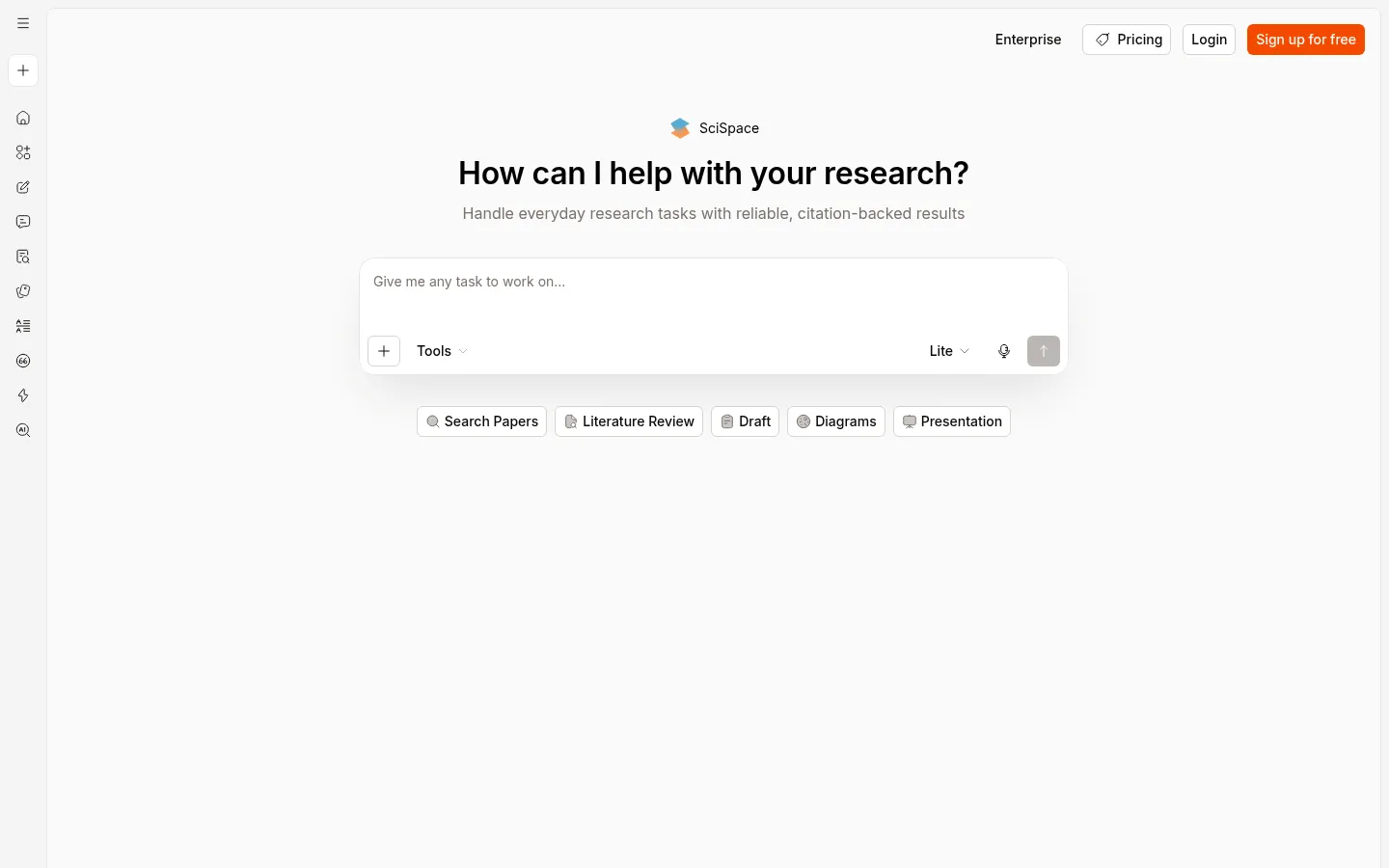
Score breakdown (0 to 5)
Search 3 · Coverage 5 · Synthesis 3 · Q&A 4 · PDF 5 · Translation 2 · Data extraction 4 · Citation trust 3 · Ease 3 · Value 3
SciSpace answers the "Scholar finds it but won't explain it" complaint better than almost anything here. It pairs the largest claimed corpus in this group (280M+ papers) with a Chat with PDF copilot that lets you highlight any passage in a result and get a plain-language explanation, with deep links back into the source. On document reading it scores a 5. For researchers who want discovery and comprehension in one place, that combination is the draw, though its discovery is notably the weaker half.
Key features
- Large literature search index (280M+ claimed) linking to real articles
- Highlight-to-explain Chat with PDF with deep links into the source
- Data extraction tables across papers
- Writing, paraphrasing, and AI-detection tools
- Chrome extension, mobile app, and a ChatGPT plugin
Strengths
SciSpace links out to genuine sources, which reviewers value as a hallucination check: one associate professor noted it "provides access or links to actual articles that you can then search, to ensure that it's not hallucinating false, nonexistent papers, like some other AI engines." It holds a 4.3 out of 5 on Capterra across 79 reviews, and its reading copilot is genuinely strong, letting you ask a difficult methods section to be explained "so that a third grader would understand it."
Weaknesses
Tellingly for a Google Scholar alternative, even SciSpace's own power-user advocates do not trust it for discovery. In a widely viewed review, Professor David Stuckler rated the tool highly overall but said its 280M+ set "is still a partial set" that creates "a little bit of a filter bubble," and that he "still officially recommend[s] Google Scholar for the process of finding papers." That is why its search scores a 3 despite the large index. Coverage also thins on hard sciences and non-English work, and the most common user complaint is opaque credit consumption that pushes you to upgrade. For readers who keep hitting those walls, our SciSpace alternatives guide compares options that bill more predictably.
Price
Free tier available. Premium is $12 per month (annual), Advanced $70 per month, and Max $160 per month, all credit-based, with Enterprise custom.
Best for
Graduate students and postdocs who want a large index plus a reader-first workspace to decode papers, and who keep Google Scholar open for exhaustive discovery.
5. Consensus: evidence-first answers to yes or no questions
Score breakdown (0 to 5)
Search 4 · Coverage 4 · Synthesis 3 · Q&A 4 · PDF 1 · Translation 0 · Data extraction 3 · Citation trust 4 · Ease 4 · Value 4
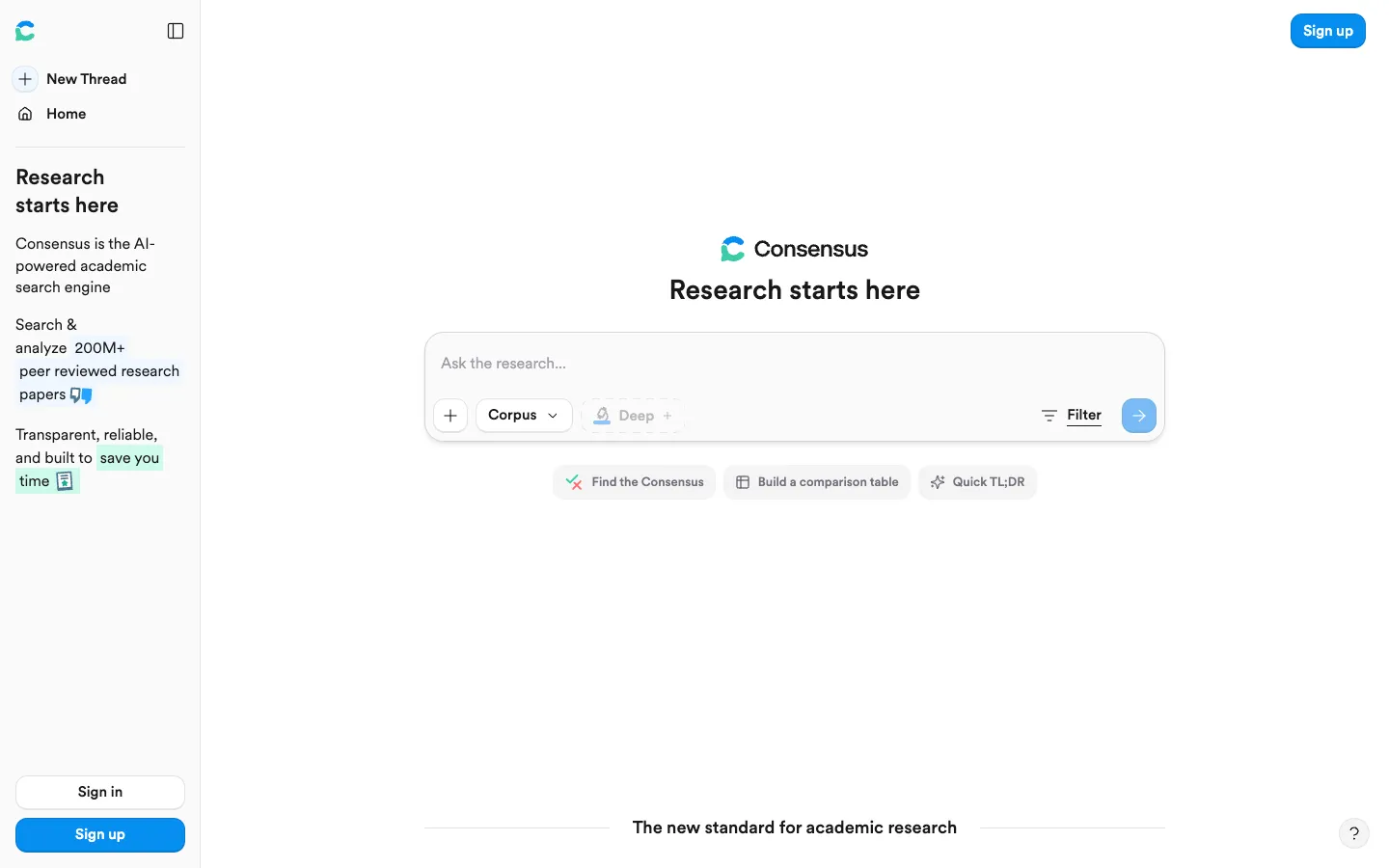
Consensus reframes the Google Scholar search as a question rather than a keyword. Built on the same Semantic Scholar 200M+ index, it reads across the literature and its Consensus Meter tells you whether studies tend to support, oppose, or are mixed on a yes or no question. Where Scholar makes you open ten links to find out what the field thinks, Consensus answers directly and shows the evidence behind the verdict, with the best pre-search filters in this comparison.
Key features
- The Consensus Meter: a support, oppose, or mixed verdict across many studies
- Best-in-class filters (year, journal rank, citation count, methodology, field, population)
- Study Snapshot extracting population, methods, outcomes, and results
- Deep Search for automated mini literature reviews
- Built on a 200M+ paper index
Strengths
For "what does the literature say" questions, Consensus is fast and the synthesis Scholar cannot do. A PhD candidate called it "essential to my dissertation workflow," and reviewers note they "tend to trust this reply over clickbait Google articles." Its filtering is unusually deep (you can scope by study type, journal quartile, and population before reading), its Study Snapshots are especially useful in medical work, and Deep Search approximates an iterative literature review from a single question.
Weaknesses
The Consensus Meter is also the boundary of the tool: it shines on yes or no questions and is weaker on open-ended or exploratory ones. There is no deep-linking into PDFs, so verifying a finding means opening the source yourself (PDF analysis scores a 1). Because results carry some randomness, they are not reproducible, which (like Scholar) makes it unsuitable as the primary search for a formal systematic review, and its index leans toward medical and social-policy research.
Price
Free (15 Pro messages per month, 3 Deep reviews per month). Pro is $10 per month and Deep $45 per month, with up to a 40% student and clinician discount and Team or Enterprise custom.
Best for
Students, researchers, and clinicians who want a fast, evidence-based verdict on a yes or no question instead of a Scholar link list.
6. Elicit: screening and extraction at systematic-review scale
Score breakdown (0 to 5)
Search 3 · Coverage 4 · Synthesis 4 · Q&A 3 · PDF 2 · Translation 0 · Data extraction 5 · Citation trust 5 · Ease 3 · Value 3
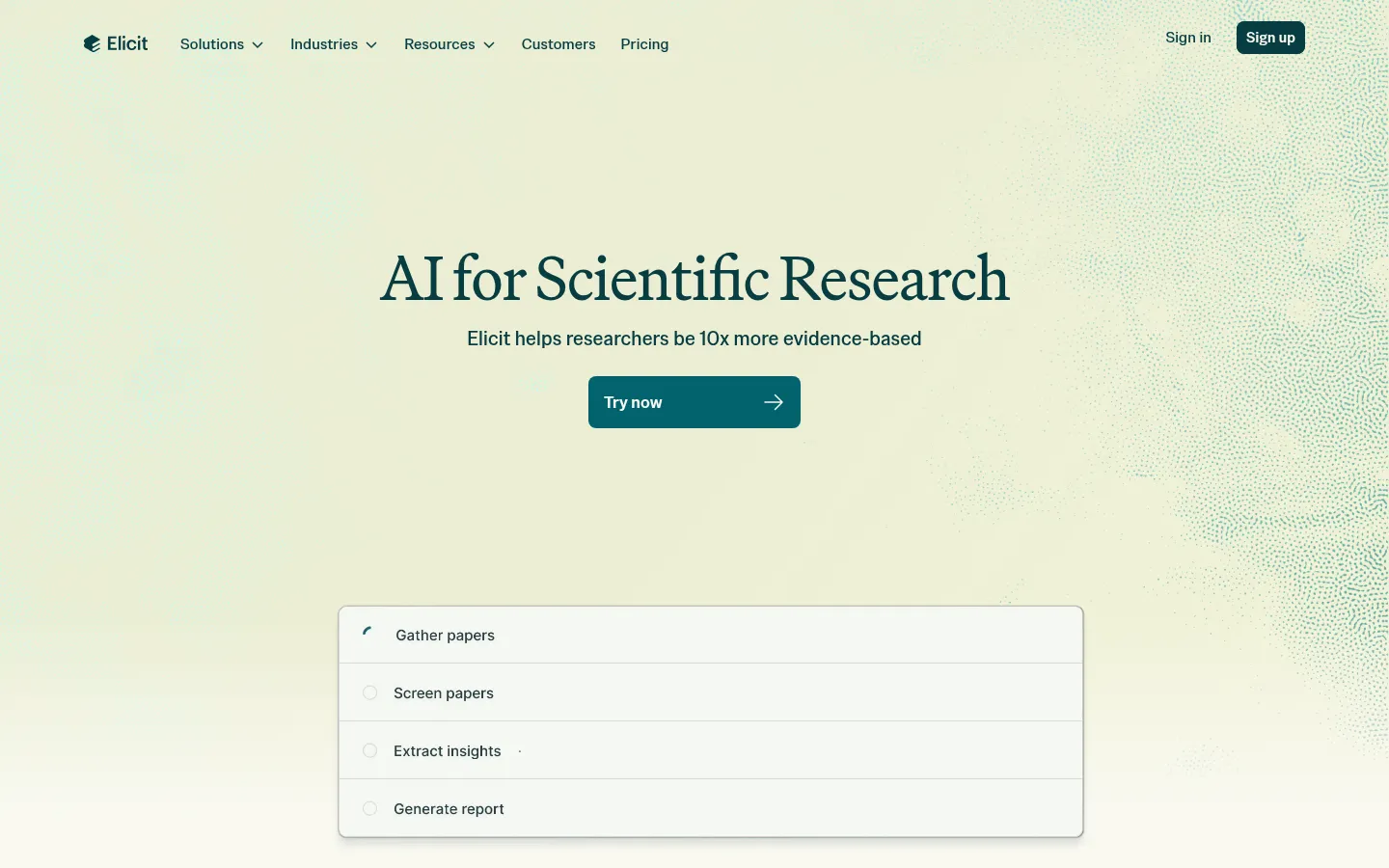
Elicit is the alternative for the rigor problem: Google Scholar is explicitly considered unfit as the primary search for a systematic review because its results are opaque and unreproducible. Elicit is built for exactly that job. It searches 138M+ papers and 545k clinical trials, then carries the results into PRISMA-style screening and structured extraction across hundreds or thousands of papers, all with sentence-level citations. It is one of two tools here to earn a 5 on citation integrity, and the only one to earn a 5 on data extraction.
Key features
- Semantic search across 138M+ papers plus 545k clinical trials
- PRISMA-style screening across thousands of papers
- Structured data-extraction tables with custom columns
- Sentence-level citations on every extracted claim
- Generous free tier with unlimited search
Strengths
Elicit's accuracy on its core task is documented: in a case study with VDI/VDE IT it correctly extracted 1,502 of 1,511 data points, and enterprise users such as Oxford PharmaGenesis report delivering literature reviews "at an unprecedented scale." Its team is unusually candid about how it controls hallucination, and it errs toward saying nothing rather than something wrong, which is the posture you want when a search feeds a formal review. For structured evidence work, it gives you the traceability Scholar's opaque results never could. For more options in this niche, see our Elicit alternatives guide.
Weaknesses
Elicit is a screening and extraction engine, not a reader or a writer: there is no upload-and-chat PDF workflow (it scores a 2 on PDF analysis) and no drafting support. Its own help center cautions that "Elicit summarizes the findings of a bad study just like it summarizes the findings of a good study," so it will not judge quality for you. A peer-reviewed evaluation found its search sensitivity averaged 39.5% against 94.5% for traditional searching, so it complements rather than replaces a thorough database run, and there is a steep jump from the free tier to the $29 Pro plan.
Price
Free (limited agent, 2 reports per month, unlimited search). Plus is about $10 per month, Pro $29 per month, and Scale $49 per month, with Enterprise custom.
Best for
Graduate students and researchers whose search is the front end of a systematic review or structured evidence extraction, where traceability matters most.
7. Semantic Scholar: smarter free discovery and the category's backbone
Score breakdown (0 to 5)
Search 4 · Coverage 4 · Synthesis 1 · Q&A 0 · PDF 1 · Translation 0 · Data extraction 0 · Citation trust 5 · Ease 4 · Value 5
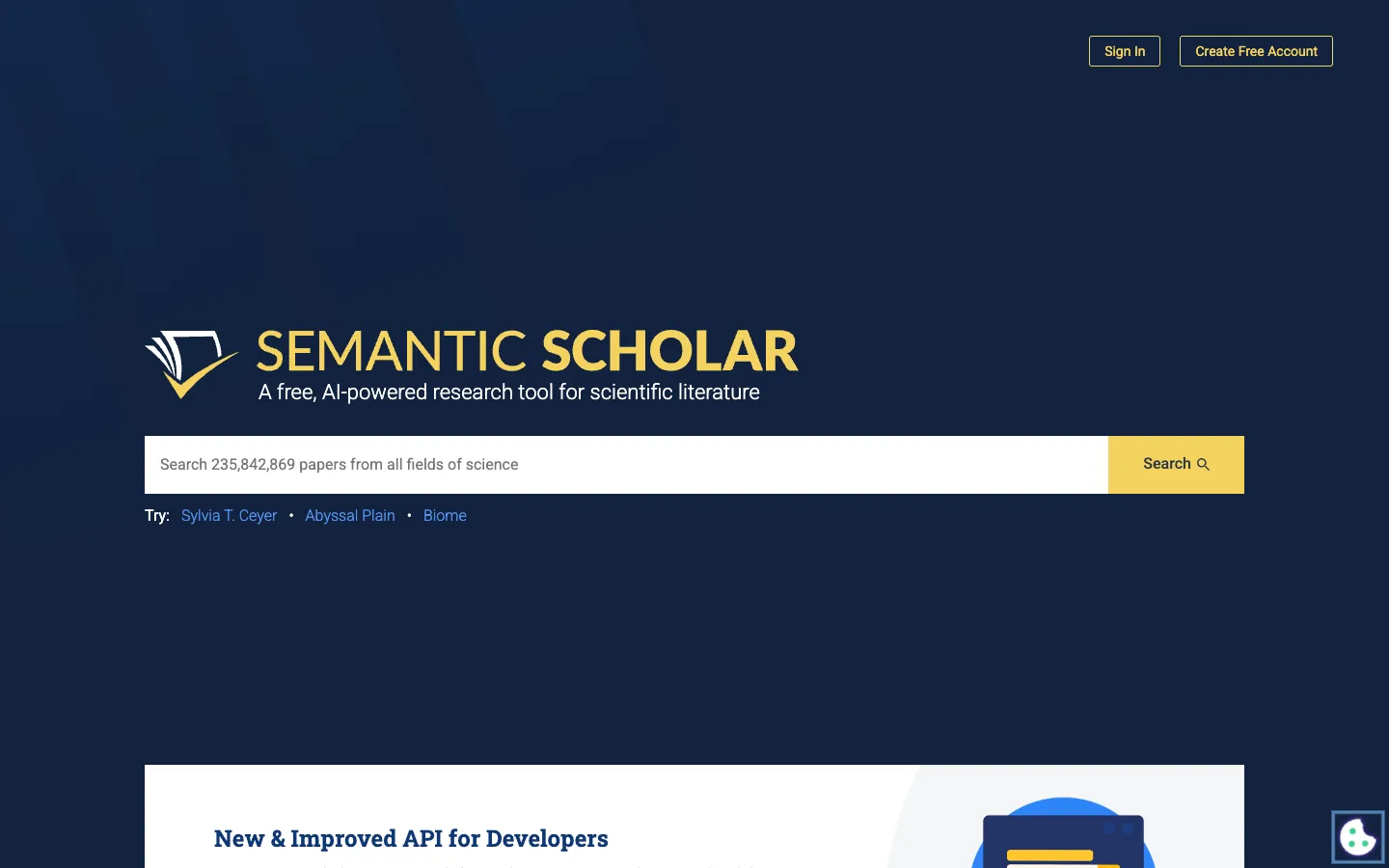
Semantic Scholar is the free alternative for researchers who want Google Scholar's price with smarter relevance and a little more help reading. Built by the non-profit Allen Institute, it explicitly aims to "combat the information overload and lack of quality assessment that many researchers experience with Google Scholar's keyword search." It searches 200M+ papers, adds one to two sentence TLDR summaries so you can judge a result at a glance, and offers a genuine citation graph and personalized Research Feeds. It also quietly powers much of this list, since Elicit, Consensus, and Kenkyu.ai all draw on its corpus or open data.
Key features
- Semantic search across 200M+ papers with relevance ranking
- TLDR one to two sentence summaries on results
- Citation graph and "Influential Citations" for chaining
- Research Feeds and email alerts personalized to your library
- Free public API and open datasets (the backbone many tools build on)
Strengths
Its search quality and TLDRs are the time-savers reviewers single out: it is "excellent for technical domains with robust synonym and concept matching," and the summaries give you the gist of a result without opening it, which is the first small step beyond what Scholar offers. Its citation graph makes related-paper discovery strong, and on Reddit researchers praise the Research Feed, with one noting it "finds and sends you papers related to an existing folder library that have been recently published." Being free and open makes it both a useful destination and the foundation many paid tools sit on.
Weaknesses
Semantic Scholar is still discovery, not synthesis: a TLDR is one sentence, not a literature-wide answer, and there is no chat or translation (synthesis scores 1, Q&A 0). Coverage is uneven by discipline, strong in computer science and biomedicine but thinner in the humanities, where Google Scholar still wins on sheer breadth. Its built-in library is primitive (many users pair it with Zotero), and it is English-centric. For tools that add real answers and translation on top of the same corpus, see our Semantic Scholar alternatives guide.
Price
Free. Semantic Scholar is a non-profit service with a free public API and open datasets, and no paid consumer tier.
Best for
Researchers who want a free, smarter Google Scholar with TLDRs and a citation graph, especially in computer science and biomedicine, plus developers who need open scholarly data.
8. ResearchRabbit: visual citation-network discovery
Score breakdown (0 to 5)
Search 4 · Coverage 4 · Synthesis 0 · Q&A 0 · PDF 0 · Translation 0 · Data extraction 0 · Citation trust 4 · Ease 4 · Value 5
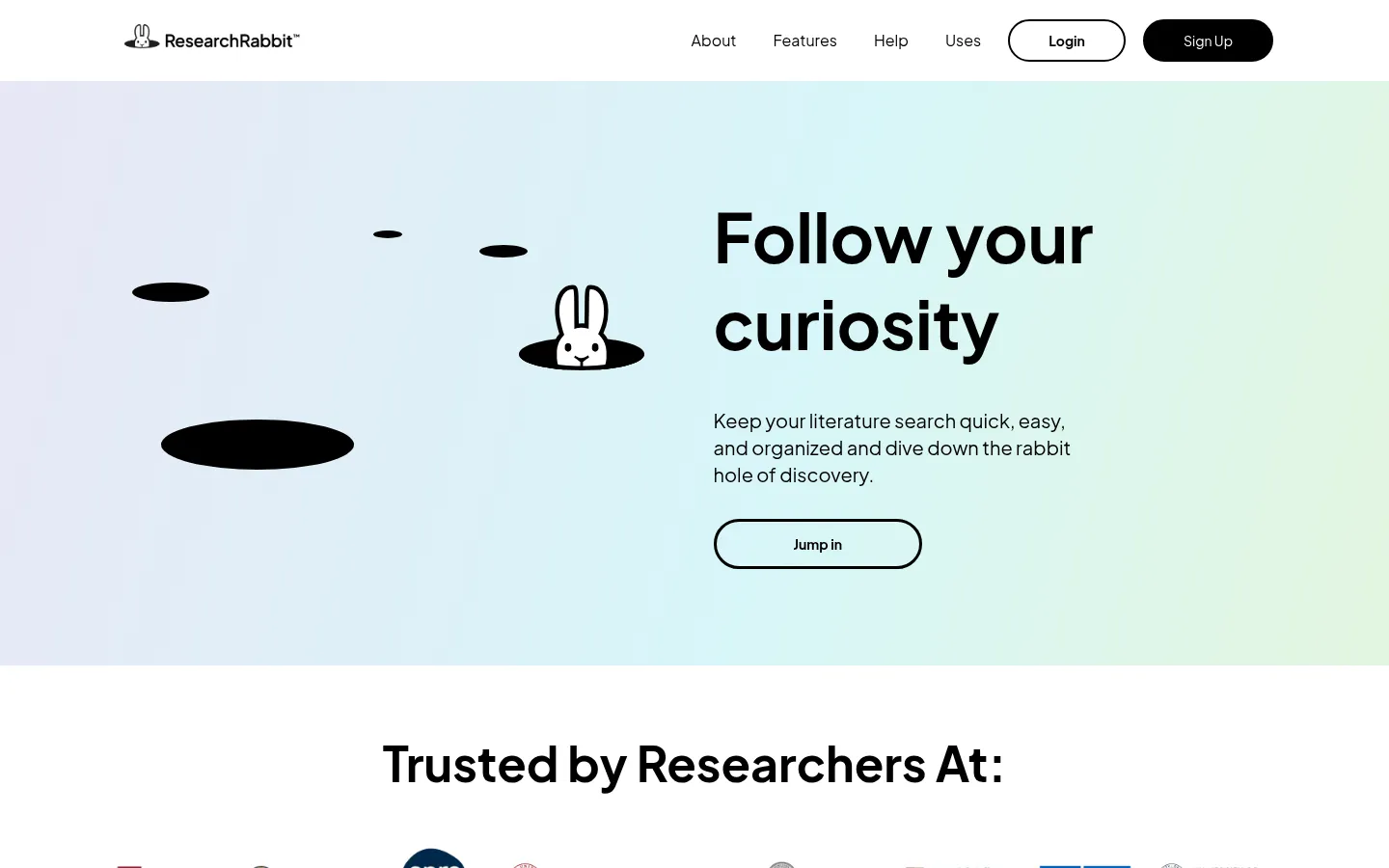
ResearchRabbit upgrades one specific Google Scholar feature: citation chaining. Scholar lets you follow "Cited by" and "Related articles" one click at a time; ResearchRabbit turns that into an interactive map. Often called "Spotify for papers," it starts from a seed paper and visualizes "Earlier Work," "Later Work," and "Similar Work" as citation networks, drawing on a large index (a claimed 280M+ papers from OpenAlex, Semantic Scholar, and PubMed). For building a literature review from scratch, the visual approach is faster than chaining links by hand, and the core workflow is free.
Key features
- Visual citation-network maps from any seed paper
- "Earlier Work," "Later Work," and "Similar Work" exploration
- Collections, notes, and alerts for new related papers
- Signature two-way Zotero sync
- Free core workflow (up to 50 seed articles)
Strengths
For exploratory discovery, the network view is the draw: reviewers note that "when building a literature review from scratch or trying to understand how ideas in a field connect over time, the visual network is genuinely faster than manual database searching," and that it "can save dozens of hours on literature review." Its two-way Zotero sync fits an existing workflow, and its database is large enough to rival or exceed Connected Papers, Scite, Consensus, and Elicit on raw coverage.
Weaknesses
ResearchRabbit upgrades chaining but nothing else: it is discovery-only, with no reading, summaries, or AI Q&A (synthesis and Q&A both score 0), so "it doesn't help much with actually reading or analyzing those papers." Export beyond Zotero is poor, coverage is uneven on niche, non-English, and older work, and there is no mobile app. A 2025 freemium pivot that added paid seed-article limits drew some user backlash. Like Scholar, it finds and connects papers but leaves the reading entirely to you.
Price
Free forever (up to 50 seed articles). ResearchRabbit+ is $10 per month (annual) for up to 300 seeds and advanced controls, with Institution pricing custom.
Best for
Graduate students and early-career academics building a literature review from scratch who want to map how a field connects, then pair it with a reading tool.
9. Google Scholar: the free baseline every alternative measures against
Score breakdown (0 to 5)
Search 4 · Coverage 5 · Synthesis 0 · Q&A 0 · PDF 0 · Translation 0 · Data extraction 0 · Citation trust 5 · Ease 5 · Value 5
Before you switch, it is worth being honest about why Google Scholar is so hard to leave entirely. It is the seed every tool above positions against, and it earns top marks on the things it does: it is free, needs no login, casts the widest net in academic search, and returns only real papers, so it scores a 5 on coverage, citation trust, ease, and value alike. For most researchers the right move is not to abandon Scholar but to add an alternative on top of it.
Key features
- The broadest free cross-disciplinary index, strong on gray literature
- "Cited by," "Related articles," and "All versions" for citation chaining
- Free author profiles, h-index, and citation metrics
- Email alerts for new matching papers and new citations
- Citation export to BibTeX, EndNote, RefMan, and RefWorks
Strengths
University library guides consistently name accessibility and breadth as Scholar's defining strengths: it is "very user friendly and similar in searching to Google," and its reach into gray literature like conference proceedings is something curated databases under-index. One peer-reviewed comparison found that against PubMed, the average Google Scholar search retrieved twice as many relevant articles with similar precision, and provided greater access to free full text. It remains the fastest path to "is there a paper on X," it never fabricates a citation, and it is the tool researchers fall back to when an AI assistant hands them a reference that does not exist.
Weaknesses
Google Scholar is a search index, not an assistant, which is the entire opening its alternatives exploit: no synthesis, no summaries, no chat, and no translation (all score 0). Its filtering is weak (you cannot reliably limit to peer-reviewed or full-text), it is opaque and unreproducible, with no published source list and location-dependent results, and it caps each query at 1,000 results with no API for bulk access. None of that makes it bad at search; it makes it incomplete for everything that comes after the search, which is what the eight tools above are for.
Price
Completely free. There is no paid tier and no API.
Best for
First-pass discovery, verification, and citation chaining, especially where breadth and free access matter most, ideally paired with an AI tool that adds synthesis and translation.
How we scored the best Google Scholar alternatives
Every tool here is scored once, on the same 13-point rubric, on a 0 to 5 scale where 0 means the capability is absent or unusable and 5 means best in class. The criteria are: search and discovery, corpus coverage, synthesis and summarization, conversational Q&A, document and PDF analysis, translation, reference management and export, writing and drafting, data extraction, citation integrity, ease of use, value, and integrations. Scores are grounded in documented features, official pricing, and real user sentiment from review sites and research communities, not vendor marketing. Vendor-reported figures such as corpus sizes and accuracy percentages are treated conservatively and labeled as claims.
For this page we weight the criteria toward what a Google Scholar alternative has to get right: search and discovery, corpus coverage, and citation integrity carry the most weight, followed by value and ease of use, then the remaining criteria at standard weight. Translation is not weighted into the ranking math here, though we still report it because it is the gap that most often sends multilingual researchers looking for an alternative in the first place. We then rank the field by that weighted result and place Google Scholar last as the baseline. Kenkyu.ai is named our Editor's pick for the cross-language upgrade job rather than the highest raw composite; on individual criteria the specialists lead where we say they do, and the full per-criterion scores below let you re-weight for your own priorities.
The full scores for all nine tools:
| Tool | Search | Coverage | Synthesis | Q&A | Translation | Ref mgmt | Writing | Extraction | Citation trust | Ease | Value | Integrations | |
|---|---|---|---|---|---|---|---|---|---|---|---|---|---|
| Kenkyu.ai | 3 | 4 | 3 | 3 | 3 | 4 | 2 | 0 | 2 | 4 | 4 | 4 | 1 |
| Paperguide | 3 | 4 | 3 | 3 | 3 | 0 | 5 | 3 | 4 | 3 | 4 | 5 | 4 |
| Undermind | 5 | 4 | 3 | 3 | 2 | 0 | 1 | 0 | 2 | 5 | 3 | 4 | 1 |
| SciSpace | 3 | 5 | 3 | 4 | 5 | 2 | 3 | 3 | 4 | 3 | 3 | 3 | 4 |
| Consensus | 4 | 4 | 3 | 4 | 1 | 0 | 2 | 0 | 3 | 4 | 4 | 4 | 2 |
| Elicit | 3 | 4 | 4 | 3 | 2 | 0 | 2 | 0 | 5 | 5 | 3 | 3 | 3 |
| Semantic Scholar | 4 | 4 | 1 | 0 | 1 | 0 | 2 | 0 | 0 | 5 | 4 | 5 | 4 |
| ResearchRabbit | 4 | 4 | 0 | 0 | 0 | 0 | 2 | 0 | 0 | 4 | 4 | 5 | 3 |
| Google Scholar | 4 | 5 | 0 | 0 | 0 | 0 | 3 | 0 | 0 | 5 | 5 | 5 | 1 |
The takeaway from the table is that no alternative beats Google Scholar at being Google Scholar. Scholar scores a 5 on coverage, ease, and value precisely because it does one thing (find real papers free) almost perfectly. Every tool above earns its place by adding a layer on top: Undermind on deep recall, Consensus and Elicit on synthesis and screening, Semantic Scholar and ResearchRabbit on smarter free discovery, and Kenkyu.ai on the combination of search, native-language translation, and source-traceable answers that Scholar leaves entirely undone.

Written by
Timothy Andersen, Kenkyu.ai Founder